Starting Year 7 is one of the biggest changes in a child’s school life: a larger building, a timetable, a different teacher for every subject, homework from several directions and a new set of friendships to build. Most children settle within the first term, and the ones who settle fastest usually have three things in place: a predictable routine, a simple system for staying organised, and an adult at home who notices early if something is slipping.
This guide covers what changes between Year 6 and Year 7, how to prepare in the summer and the first weeks, how to support homework without doing it, and the signs that your child might need a little extra help, academically or emotionally.
Whether your child is starting at a Milton Keynes secondary or travelling further afield, the principles are the same. Small, practical habits put in place early make the rest of KS3 much smoother.
In this guide, we’ll cover:
- What Changes Between Year 6 and Year 7
- Preparing in the Summer Before Year 7
- The First Weeks: Building a Routine That Sticks
- Organisation Skills Every Year 7 Needs
- Supporting Homework Without Doing It for Them
- Friendships, Confidence and Wellbeing
- Spotting Learning Gaps Early in KS3
- How Small-Group Tuition Can Help in Year 7
- Starting Year 7 With Confidence
- Frequently Asked Questions
What Changes Between Year 6 and Year 7
In primary school, most children spend the day with one class teacher in one room. In Year 7 that changes almost overnight.
- Many teachers, many rooms. Your child may see eight or more different teachers in a week, each with their own expectations, seating plans and homework style.
- A timetable. Lessons change every hour or so, often on a one- or two-week cycle, and your child needs to be in the right place with the right equipment.
- New subjects. Languages, separate science lessons, design and technology, computing and others may be taught by specialists for the first time.
- More independence. Children are expected to manage their own planner, bag and deadlines, and to ask for help themselves.
- A bigger social world. Friendship groups from primary school often spread across different forms, and new ones form quickly.
None of this is a problem in itself. It is simply a lot of new information at once, and children deal with it in different ways. Some are energised; others are exhausted for the first few weeks. Both are normal.
BBC Bitesize has a helpful collection of starting secondary school articles and videos written for children, which can be a good way to start conversations at home.
Preparing in the Summer Before Year 7
The summer holiday is a chance to make the unknown feel familiar. You do not need to turn it into a study programme.
1Practise the Journey
If your child will walk, cycle or take a bus to school, do the journey together at least once at the right time of day. In Milton Keynes, that might mean working out the redway route or which bus stop to use. Then let your child lead the way on a second run.
2Get Familiar With the School
Read through the school’s welcome pack together, look at the map if there is one, and talk about the transition days your child attended. What did they like? What worried them? Write down any questions to ask in the first week.
3Keep Reading and Number Skills Ticking Over
A few minutes of reading most days and a little number practice help prevent the summer dip. Our guide to keeping kids learning over the summer holidays has easy ideas that do not feel like extra school.
4Shift Sleep Back Gradually
In the last week or two of the holiday, move bedtime and wake-up time back towards term-time hours. Starting Year 7 tired makes everything harder.
The First Weeks: Building a Routine That Sticks
The first half-term is when habits form. A simple, repeatable routine takes a lot of daily decision-making off your child’s shoulders.
- Evening bag check: look at tomorrow’s timetable, pack the bag and lay out PE kit the night before. Mornings are not the time to hunt for a calculator.
- A fixed homework slot: the same time most days, after a snack and a short break.
- A screen cut-off: devices out of the bedroom at night protects sleep, which affects concentration the next day. Our article on screen time and concentration explains why.
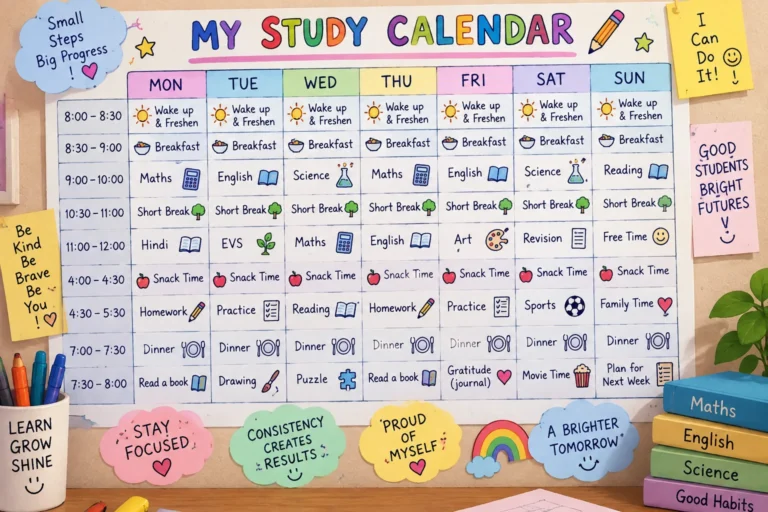
- A weekly check-in: ten minutes at the weekend to look at the planner together, check upcoming deadlines and talk about the week.
Expect some wobbles. Forgotten homework and lost jumpers are almost universal in the first term. The goal is to treat them as problems to solve together rather than failures.
Organisation Skills Every Year 7 Needs
Organisation is the skill that most often separates children who cope comfortably with Year 7 from those who feel constantly behind. It can be taught.
1Use the Planner or App Properly
Most schools use a paper planner, an online homework platform, or both. Make sure your child knows how to log in and where to find set work. Encourage them to write homework down in the lesson, with the due date, rather than trying to remember it later.
2A Copy of the Timetable at Home
Stick a copy on the fridge or bedroom wall. Colour-coding subjects helps younger children see the pattern of the week.
3One Place for Everything
A shelf or box for each subject’s books, a pencil case that is refilled every Sunday, and a hook for the school bag sound basic, but they prevent daily panic.
4Break Bigger Tasks Down
Some Year 7 homework is set over a week or more. Show your child how to split it into two or three smaller steps and write each one into the planner on a different day.
Supporting Homework Without Doing It for Them
Year 7 homework is often designed to build independence as much as knowledge. Your role is to create the conditions for it, not to complete it.
- Provide a quiet, well-lit space with a clear surface and the phone elsewhere.
- Ask your child to explain the task to you before they start. If they cannot, they need to check the instructions or ask the teacher.
- Be available, but do not hover. Answer questions with questions: “What did your teacher show you in class?” “Where in your book is the example?”
- If homework regularly takes far longer than expected, or your child is consistently confused, mention it to the form tutor or subject teacher early.
Good study habits formed now will matter a great deal by GCSE. Our guide to study techniques that work from KS2 to GCSE introduces methods like retrieval practice and spaced revision in a way Year 7s can start using straight away.
Friendships, Confidence and Wellbeing
For many children, the social side of starting Year 7 feels bigger than the academic side. Old friendships may change and new ones take time.
- Encourage clubs. Lunchtime and after-school clubs are one of the easiest ways to meet people with shared interests.
- Listen more than you advise. Children often talk more in the car, while cooking or on a walk than when asked directly at the table.
- Normalise ups and downs. Let your child know that feeling unsettled for a few weeks is common and usually passes.
- Know who to contact. The form tutor is usually the first point of contact for pastoral concerns. Most schools also have a head of year and a pastoral team.
If worries about school continue, affect sleep or eating, or your child seems persistently low, take it seriously. The NHS has clear advice for parents on children’s mental health, including when to speak to a GP.
Spotting Learning Gaps Early in KS3
Secondary teachers have many more pupils than a primary class teacher, so small gaps can go unnoticed for a while. KS3 builds directly on KS2, particularly in maths and English, so an unresolved gap from primary school can start to show quickly.
Signs worth watching for in the first term:
- Maths homework that takes much longer than other subjects, or frequent comments about times tables, fractions or written methods.
- Reluctance to read aloud, or difficulty summarising what a text was about.
- Writing that is much shorter than classmates’ or full of basic punctuation errors.
- Low marks on early baseline or end-of-unit tests, or teacher comments about rushing or not finishing.
- Your child saying they “don’t get” a subject, or avoiding it entirely.
Most schools run a parents’ evening or send an early progress report in Year 7. Use it to ask specific questions: “Is my child working at the level you would expect?” “Is there one thing we could practise at home?”
How Small-Group Tuition Can Help in Year 7
For some children, a little extra support in Year 7 makes the step up far less stressful. Closing a gap in fractions or sentence structure early is much easier than tackling it in Year 10.
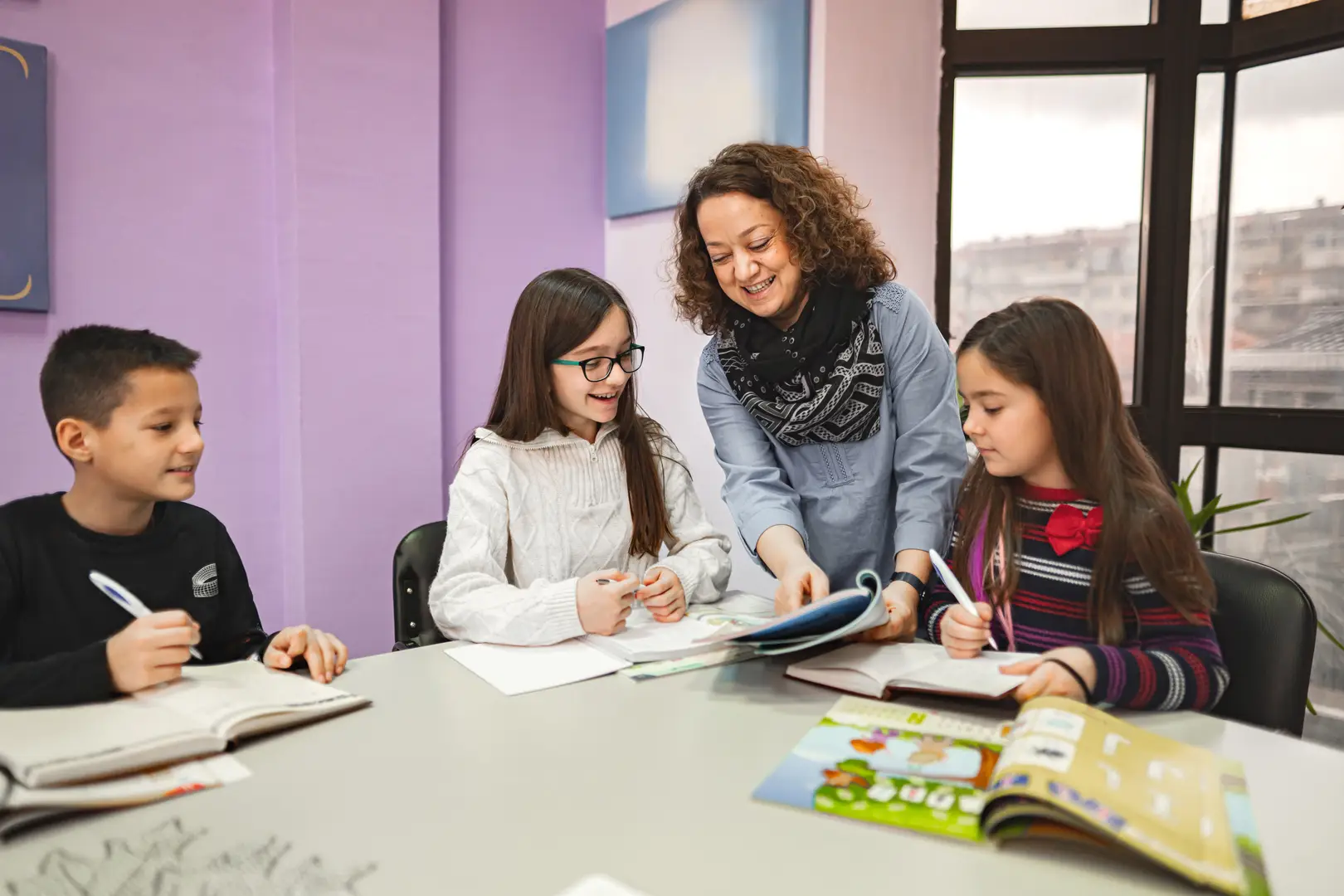
At PrimePlus UK we teach KS3 Maths, English and Science in groups of no more than three learners at our Milton Keynes centres. That size means a tutor can check each child’s understanding during the session, revisit Year 6 foundations where needed, and build the confident, organised study habits that secondary school expects. It also gives quieter children space to ask questions they might not ask in a large class.
You can read more about our KS3 Maths, English and Science tuition, or start with a free assessment so we can see where your child is and suggest a sensible plan.
Give your child a confident start to secondary school.
Our KS3 groups of no more than three help children close gaps from primary and build strong study habits. Book a free assessment to get started.
Starting Year 7 With Confidence
The move to secondary school is a big step, but it is one that children all over the country make every September. With a steady routine, simple organisation systems, a calm approach to homework and an eye on early warning signs, most children find their feet within weeks.
Keep the conversation open, celebrate small wins like a well-organised bag or a new friendship, and act early if something is not going right. The habits your child forms in Year 7 will carry them through KS3 and into GCSE.
Frequently Asked Questions
How long does it take a child to settle into Year 7?
It varies. Many children feel more settled by the end of the first half-term, while others take most of the autumn term. If your child is still very unhappy after several weeks, speak to their form tutor.
How much homework should a Year 7 expect?
Each school sets its own homework policy, so check the school website or ask the form tutor. If homework regularly takes much longer than the school expects, let the teacher know.
How can I help my Year 7 child get organised?
Put a copy of the timetable on the wall, pack the bag the night before, keep a regular homework slot and do a short weekly planner check together. Simple systems work best.
Who should I contact if my child is struggling at secondary school?
The form tutor is usually the first point of contact for both academic and pastoral concerns. They can involve subject teachers, the head of year or the pastoral team if needed.
Is Year 7 a good time to start tuition?
It can be, especially if there are gaps from primary school in maths or English. Addressing them early in KS3 is usually easier than waiting until GCSE years.
Support your child through Year 7 and KS3 with small-group tuition in Milton Keynes.
Book a free assessment to understand your child’s strengths and any gaps before they grow.