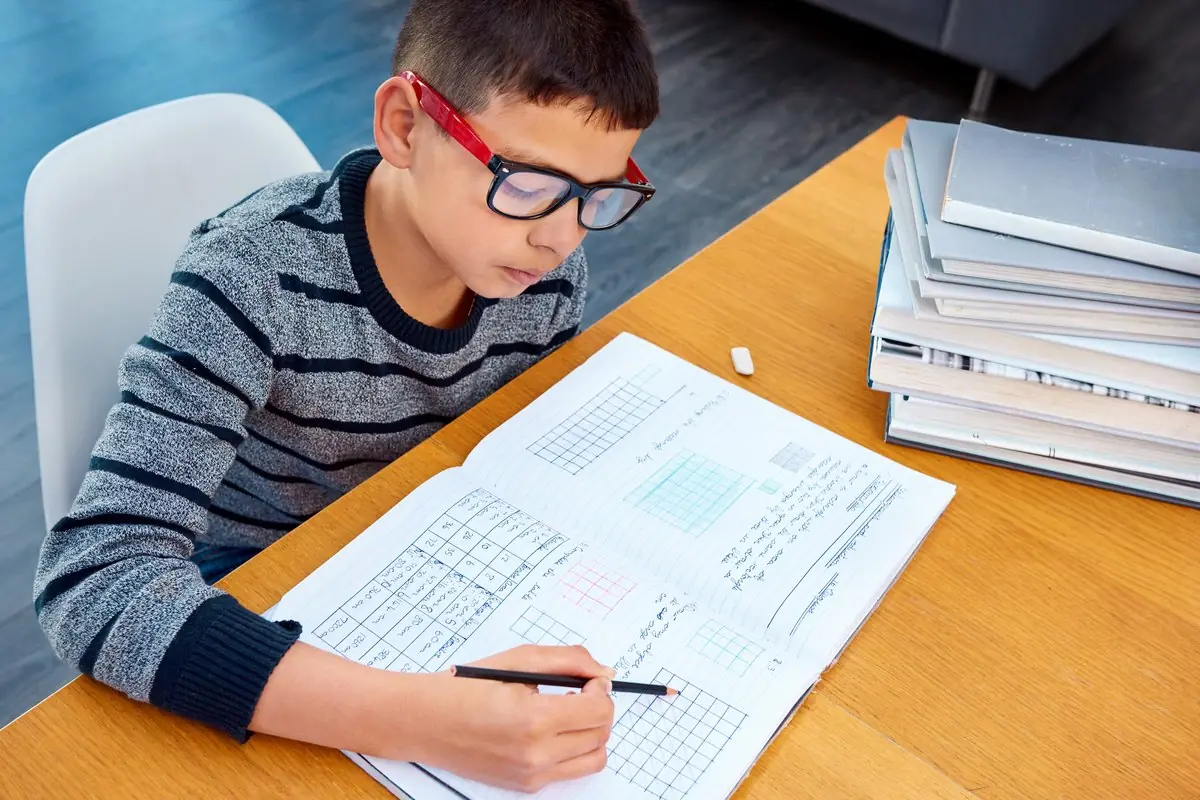
Year 7 algebra is mostly about three ideas: using letters to stand for numbers, simplifying expressions by collecting like terms, and solving simple equations to find an unknown value. Secondary school is where it becomes a regular part of maths lessons, and it underpins most of what follows at GCSE. If your child is finding it strange, the good news is that the core rules are consistent, and you can support them at home even if you have not done algebra for years.
Key takeaways
- An expression (such as 3x + 2) has no equals sign; an equation (such as 3x + 2 = 14) does, and can be solved.
- Simplifying means collecting like terms: 4a + 3b + 2a becomes 6a + 3b.
- Equations are solved by doing the same inverse operation to both sides.
- Many early mistakes come from notation: 3x means 3 × x, and x² is not 2x.
- Checking an answer by substituting it back is a habit worth building from Year 7.
In this guide, we’ll cover:
- What algebra does Year 7 cover?
- Expressions, equations and formulae: what is the difference?
- Simplifying expressions by collecting like terms
- Solving equations in Year 7
- Common mistakes in Year 7 algebra
- How parents can help with KS3 algebra at home
- Frequently asked questions
- What to do next
What algebra does Year 7 cover?
The national curriculum for key stage 3 mathematics expects pupils to use and interpret algebraic notation, substitute numerical values into formulae and expressions, use algebraic methods to solve linear equations in one variable, and recognise arithmetic sequences and find the nth term. Schools spread this content across Years 7 to 9, in their own order. Early topics typically look like this:
| Topic | Example | What it means |
|---|---|---|
| Algebraic notation | 3n, n/2, n² | 3 × n, n ÷ 2, n × n |
| Writing expressions | “5 more than n” is n + 5 | Turning words into algebra |
| Substitution | If a = 4, 3a + 1 = 13 | Replacing letters with numbers |
| Collecting like terms | 2x + 5x = 7x | Combining terms with the same letter |
| Expanding a single bracket | 3(x + 2) = 3x + 6 | Multiplying each term inside |
| Solving equations | x + 7 = 12, so x = 5 | Finding the unknown value |
| Sequences | 4, 7, 10, 13 has nth term 3n + 1 | Describing a pattern with algebra |
The exact order depends on your child’s school scheme of work. If you are not sure what they are covering this half term, the maths department can usually tell you, or check your child’s exercise book for the latest topic heading.
Expressions, equations and formulae: what is the difference?
Students are often asked to identify these, and the words get mixed up.
- Term: a single part, such as 4x or 7 or 3ab.
- Expression: terms combined with + or −, with no equals sign. Example: 4x + 7.
- Equation: an expression set equal to something, true for particular values. Example: 4x + 7 = 19, which is true only when x = 3.
- Formula: a rule linking two or more quantities. Example: P = 2l + 2w for the perimeter of a rectangle.
- Identity: true for every value, written with the symbol ≡. Example: 2(x + 1) ≡ 2x + 2.
A simple test: if you can solve it to get a number, it is an equation. If you can only simplify it, it is an expression.
Simplifying expressions by collecting like terms
Like terms have exactly the same letters raised to the same powers. Think of them as the same kind of object. You can add apples to apples, but you cannot turn apples and bananas into one number.
Worked example
Simplify 5a + 3b − 2a + 4b.
- Find the a terms: +5a and −2a. Together they make 3a.
- Find the b terms: +3b and +4b. Together they make 7b.
- Answer: 3a + 7b.
The sign in front of a term belongs to it. A useful habit is to circle each term with its sign before collecting.
Terms that look alike but are not
- x and x² are not like terms. 3x + 2x² cannot be simplified further.
- ab and ba are like terms, because multiplication works in any order. 2ab + 3ba = 5ab.
- A number on its own (a constant) is only like other constants: 4x + 3 + 2 = 4x + 5.
Solving equations in Year 7
The idea that unlocks equations is balance. An equation is like a set of scales: whatever you do to one side, you must do to the other to keep it level. To find the unknown, undo what has been done to it, in reverse order, using inverse operations.
One-step equations
- x + 9 = 15: subtract 9 from both sides, x = 6.
- 4x = 28: divide both sides by 4, x = 7.
- x / 3 = 5: multiply both sides by 3, x = 15.
Two-step equations
Solve 3x + 5 = 20.
- The x has been multiplied by 3, then 5 added. Undo in reverse: subtract 5 first. 3x = 15.
- Then divide by 3. x = 5.
- Check: 3 × 5 + 5 = 20. Correct.
Many schools also teach “function machines” for this: x goes in, is multiplied by 3, has 5 added, and 20 comes out. Running the machine backwards gives the answer. It is the same logic in a picture, and it suits children who are not yet comfortable with the balance idea.
Common mistakes in Year 7 algebra
Many early algebra errors come from a handful of misunderstandings. Spotting them at home is easy once you know what to look for.
| Mistake | Example | The fix |
|---|---|---|
| Reading 3x as 3 plus x | If x = 4, says 3x = 7 | 3x means 3 lots of x, so 12 |
| Confusing x² with 2x | If x = 5, says x² = 10 | x² = x × x, so 25 |
| Combining unlike terms | 2a + 3b = 5ab | Different letters stay separate |
| Losing the sign | 6x − 2x + x = 3x | Keep each sign with its term: 5x |
| Only multiplying the first term in a bracket | 4(x + 3) = 4x + 3 | Multiply every term: 4x + 12 |
| Doing an operation to one side only | x + 4 = 10 becomes x = 10 | Subtract 4 from both sides |
How parents can help with KS3 algebra at home
You do not need to reteach the topic. The most useful support is asking your child to explain what they did, because explaining exposes gaps.
- Ask “what does that letter stand for?” If your child can say “the number of sweets” or “any number”, they understand that letters represent values.
- Play “think of a number”. “I think of a number, double it and add 3. I get 17. What was my number?” That is 2n + 3 = 17 in disguise.
- Use real formulae. The cost of a taxi ride, or a phone contract with a fixed fee plus a charge per gigabyte, is a formula.
- Encourage checking. Substituting the answer back into the equation is one of the most useful habits to build now.
- Look at the methods they learnt in primary. Algebra builds on arithmetic, and our guide to primary maths methods explained for parents covers those foundations.
Year 7 is a big change in many ways, not just in maths. Our post on starting Year 7 at secondary school covers homework, organisation and settling in.
Frequently asked questions
Why do we use x in algebra?
The letter x is simply a convention for an unknown number, and any letter would work. In Year 7, pupils often use letters linked to the context, such as c for cost or n for the number of items, which helps them remember what the letter represents. The important idea is that the letter stands for a value.
What is the difference between simplifying and solving?
Simplifying makes an expression shorter by collecting like terms, and the answer is still algebra, such as 7x + 2. Solving finds the value of the unknown in an equation, and the answer is a number, such as x = 4. You can only solve something that has an equals sign.
What should my child do when they get stuck on an equation?
Ask them to say in words what has happened to the unknown, for example “x was multiplied by 3, then 5 was added”. Then undo those steps in reverse order, doing the same to both sides each time. Drawing a function machine or a balance can help. Finally, substitute the answer back in to check it.
How can I tell if my child is falling behind in algebra?
Signs include guessing answers rather than showing steps, confusing 3x with 3 + x after several weeks of teaching, or homework that takes much longer than expected. Ask your child to talk you through one question. If they cannot explain any step, a quiet word with the maths teacher is a sensible next move.
What to do next
This week, ask your child to show you one algebra question from their book and explain each step. Then try a round of “think of a number” at dinner. If algebra is causing frustration, early help in Year 7 prevents bigger gaps at GCSE. Our KS3 maths tuition in Milton Keynes offers small-group and online tuition, and a free assessment will show where your child stands.
Next step: Book a free assessment with PrimePlus and we will identify gaps, explain where your child is now and suggest a clear plan. Book your free assessment.