Teaching kids to tell the time works best in small steps, in the same order the national curriculum uses: o’clock and half past in Year 1, quarter past, quarter to and five-minute times in Year 2, the nearest minute, Roman numerals and 24-hour clocks in Year 3, and converting between analogue and digital 12- and 24-hour clocks in Year 4. Each step relies on the one before, so make sure one is secure before moving on, and practise with a real analogue clock where your child can move the hands.
Key takeaways
- Year 1: tell the time to the hour and half past, and draw the hands on a clock face.
- Year 2: tell and write the time to five minutes, including quarter past and quarter to.
- Year 3: read analogue clocks to the nearest minute, including Roman numerals I to XII, and 12- and 24-hour clocks.
- Year 4: read, write and convert time between analogue and digital 12- and 24-hour clocks.
- A clock with movable hands, plus everyday talk about time, does most of the work.
In this guide, we’ll cover:
- What the national curriculum expects, year by year
- Before the clock: the language of time
- Step 1: o’clock and half past
- Step 2: quarter past, quarter to and five minutes
- Step 3: to the nearest minute, Roman numerals and am/pm
- Step 4: the 24-hour clock
- Working out how long something takes
- Everyday ways to practise
- Frequently asked questions
- Next steps
What the national curriculum expects, year by year
The national curriculum for mathematics spreads telling the time across Years 1 to 4. These are the main statutory statements on time:
| Year | What pupils should be taught |
|---|---|
| Year 1 | Compare time (quicker, slower, earlier, later); measure and begin to record time (hours, minutes, seconds); sequence events using words such as before, after, next, first, today, yesterday, tomorrow, morning, afternoon and evening; use language about dates, including days of the week, weeks, months and years; tell the time to the hour and half past the hour and draw the hands on a clock face to show these times |
| Year 2 | Compare and sequence intervals of time; tell and write the time to five minutes, including quarter past/to the hour, and draw the hands on a clock face; know the number of minutes in an hour and the number of hours in a day |
| Year 3 | Tell and write the time from an analogue clock, including Roman numerals from I to XII, and 12-hour and 24-hour clocks; estimate and read time with increasing accuracy to the nearest minute; record and compare time in seconds, minutes and hours; use vocabulary such as o’clock, am/pm, morning, afternoon, noon and midnight; know the number of seconds in a minute and the days in each month, year and leap year; compare durations of events |
| Year 4 | Read, write and convert time between analogue and digital 12- and 24-hour clocks; solve problems converting hours to minutes, minutes to seconds, years to months and weeks to days |
If your child is younger or finding it hard, start at the step that matches what they can already do, not their year group.
Before the clock: the language of time
Children need words for time before they can read a clock. Year 1 starts here, with ordering events and comparing them: quicker, slower, earlier, later. You can build this at home without any equipment:
- Talk through the day in order: “First breakfast, then school, after school we go to the park.”
- Use the days of the week: “Today is Tuesday. Tomorrow is swimming.”
- Compare: “Who got dressed quicker, you or me?”
- Make a simple picture timetable for the morning routine.
This sense of order and length is what makes the numbers on a clock meaningful later.
Step 1: o’clock and half past
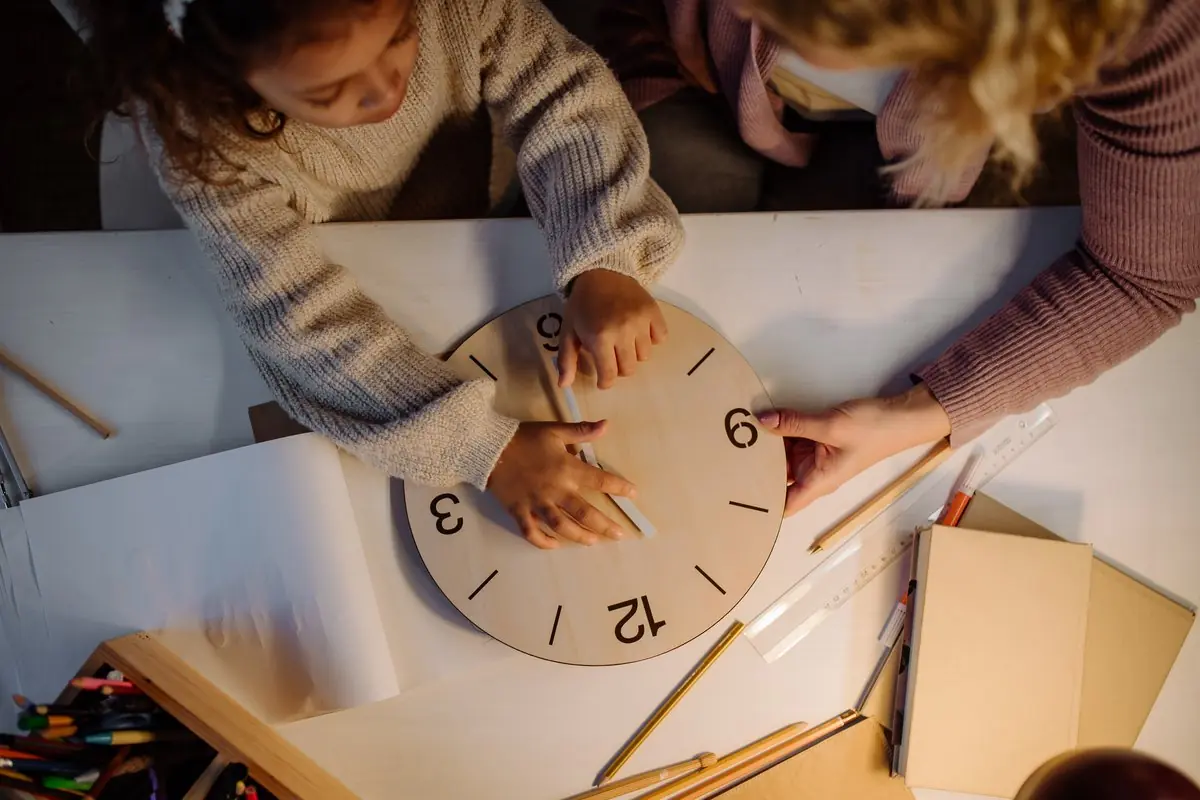
Start with a clock that has movable hands. A toy clock or a paper plate with card hands both work.
- Name the hands. The short hand shows the hour. The long hand shows the minutes.
- O’clock first. When the long hand points straight up to 12, it is something o’clock. The short hand tells you which hour.
- Half past. When the long hand points straight down to 6, it has gone half way round: half past. Point out that the short hand is now half way between two numbers.
- Swap roles. Say a time and let your child set the clock. Then let them draw the hands on a blank clock face, which the Year 1 curriculum asks for.
Link it to real events: “Tea is at 5 o’clock. Let’s see what the clock looks like at 5 o’clock.”
A common confusion
At half past 3, the short hand sits between 3 and 4. It is easy to read it as 4. Remind them that the hour hand has not reached 4 yet, so it is still 3-something.
Step 2: quarter past, quarter to and five minutes
Year 2 moves on to quarters and five-minute steps, and to knowing that there are 60 minutes in an hour and 24 hours in a day.
Quarter past and quarter to
Fold a paper circle into quarters, or cut a paper plate into four pieces, to show that a quarter of the way round is at the 3 and three quarters of the way round is at the 9. Long hand on 3: quarter past. Long hand on 9: quarter to the next hour.
“Quarter to” can be tricky, because the hour named is the one coming next. At quarter to 4, the short hand is nearly at 4 but not yet there.
Counting in fives
Each number on the clock face is 5 minutes along from the one before. If your child can count in fives, they can read five-minute times:
| Long hand on | Minutes past | Also said as |
|---|---|---|
| 1 | 5 | 5 past |
| 2 | 10 | 10 past |
| 3 | 15 | quarter past |
| 4 | 20 | 20 past |
| 5 | 25 | 25 past |
| 6 | 30 | half past |
| 7 | 35 | 25 to |
| 8 | 40 | 20 to |
| 9 | 45 | quarter to |
| 10 | 50 | 10 to |
| 11 | 55 | 5 to |
Teach the “past” side (right half of the clock) first, then the “to” side (left half). Writing small 5, 10, 15… labels round the outside of a paper clock helps at first; remove them once your child is confident.
Step 3: to the nearest minute, Roman numerals and am/pm
In Year 3 children read the time to the nearest minute. Count in fives to the last number the long hand passed, then count on the single minute marks. At 7:23, the long hand has passed the 4 (20 minutes), then three small marks more: 23 minutes past 7.
Year 3 also includes clock faces with Roman numerals from I to XII. A quick reference helps:
| Number | 1 | 2 | 3 | 4 | 5 | 6 | 7 | 8 | 9 | 10 | 11 | 12 |
|---|---|---|---|---|---|---|---|---|---|---|---|---|
| Roman | I | II | III | IV | V | VI | VII | VIII | IX | X | XI | XII |
Children also learn am and pm, noon and midnight, and that there are 60 seconds in a minute. A simple way to explain am and pm: am runs from midnight to noon, pm from noon to midnight.
Step 4: the 24-hour clock
The 24-hour clock appears in Year 3, and in Year 4 children read, write and convert between analogue and digital 12- and 24-hour times. The rule is straightforward:
- Morning times stay the same, written with four digits: 7:15 am is 07:15.
- From 1 pm onwards, add 12 to the hour: 3:40 pm is 15:40.
- Noon is 12:00. Midnight is 00:00. The 12 o’clock hours are the exceptions: 12:30 pm stays 12:30, and 12:30 am is 00:30.
To go the other way, subtract 12 from any hour above 12: 19:05 is 7:05 pm. Train timetables, cooker clocks and phone settings are good real-world practice.
Working out how long something takes
Year 3 compares durations and Year 4 converts between units such as hours and minutes. Duration questions are easier with a number line than with subtraction. To find the time from 9:45 to 11:10:
- Jump to the next hour: 9:45 to 10:00 is 15 minutes.
- Jump whole hours: 10:00 to 11:00 is 1 hour.
- Jump the rest: 11:00 to 11:10 is 10 minutes.
- Add the jumps: 1 hour 25 minutes.
Subtracting 9.45 from 11.10 as if they were decimals gives a wrong answer, because an hour has 60 minutes, not 100. The number line avoids that trap. Our guide to primary maths methods explained for parents covers number lines and other methods used in school.
Everyday ways to practise
- Clock check-ins: ask “What time is it?” a few times a day, using an analogue clock at home.
- Countdowns: “We leave at quarter past 8. How long is that?”
- Timers: guess how long a task takes, then time it.
- TV and timetables: find when a programme starts in 24-hour time.
- Clock snap: match cards showing analogue clocks, digital times and written times.
Our post on fun maths games for KS1 and KS2 has more game ideas.
Frequently asked questions
What age should a child be able to tell the time?
The national curriculum introduces telling the time to the hour and half past in Year 1, and five-minute times including quarter past and quarter to in Year 2. Reading to the nearest minute and the 24-hour clock come in Year 3, with converting between formats in Year 4. Children vary, so build on what your child can already do.
Should I teach analogue or digital time first?
The curriculum starts with the clock face: Year 1 children tell the time to the hour and half past and draw the hands on a clock face. Digital 12- and 24-hour times are developed later. Starting with an analogue clock helps children see how far round the hour has gone.
Why does my child find quarter to so hard?
“Quarter to” names the hour that is coming next, while the short hand has not quite reached it. Practise by setting the clock to quarter to and asking, “What hour is the short hand nearly at?” Then ask them to say the time aloud.
How do I explain the 24-hour clock?
Explain that the day has 24 hours, so instead of starting again at 1 after noon, the numbers keep going: 1 pm is 13:00, 2 pm is 14:00, and so on. For times from 1 pm onwards, add 12 to the hour. To change back, take 12 away.
Next steps
Find the step your child can already do confidently, then practise the next one for a few minutes a day this week with a clock they can move. If maths more widely is a worry, our KS1 maths tuition in Milton Keynes offers small-group and online tuition, and a free assessment shows where your child is starting from.
Next step: Book a free assessment with PrimePlus and we will identify gaps, explain where your child is now and suggest a clear plan. Book your free assessment.