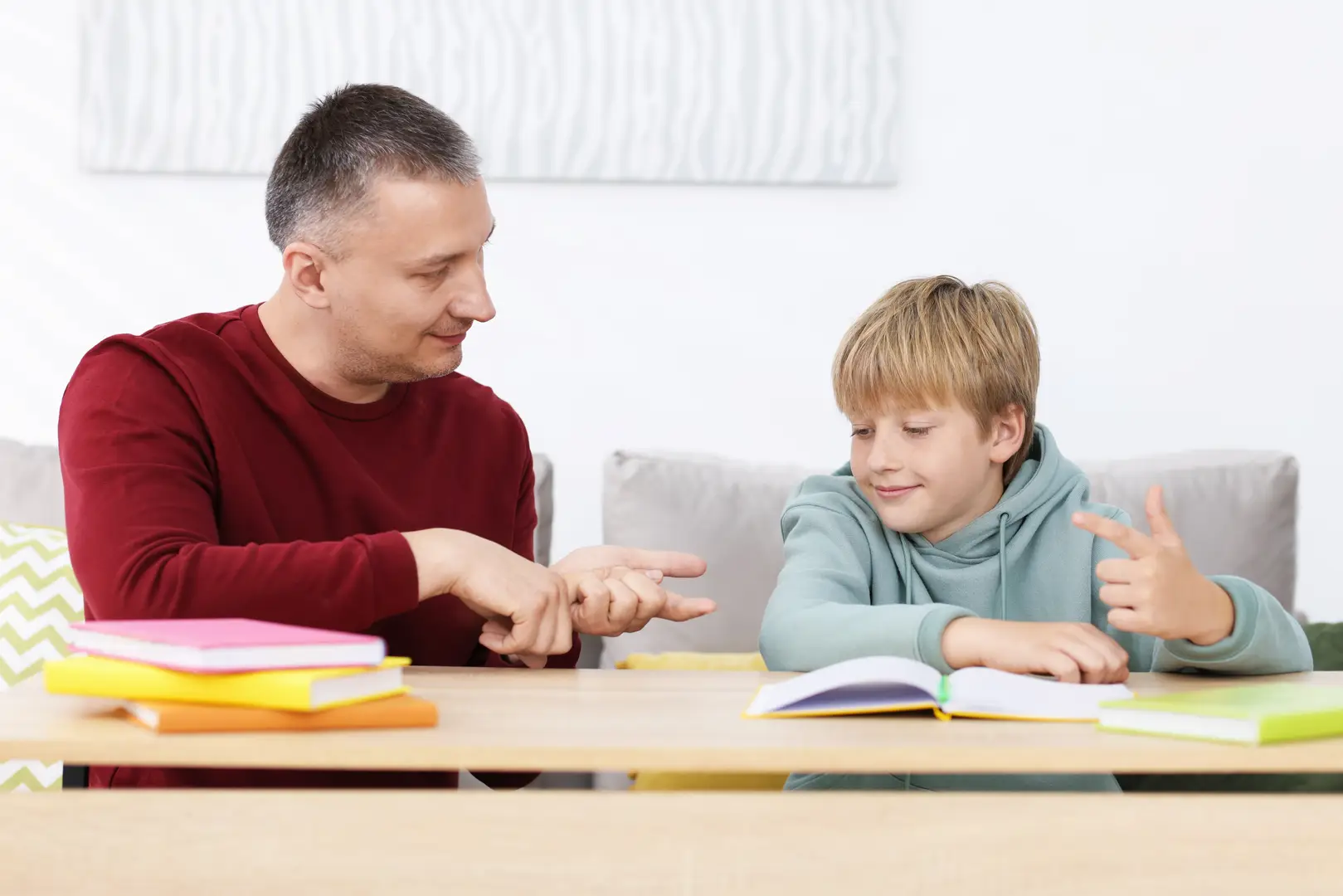
The most common signs of dyscalculia in children include taking a long time to learn to count objects, needing to count every item to know how many there are, relying on fingers for simple sums, difficulty remembering number facts and times tables, and trouble telling the time or understanding money. The British Dyslexia Association (BDA) describes dyscalculia as a specific learning difficulty that fundamentally affects a person’s ability to understand and process numbers.
Many children find maths hard at some point, and most of them do not have dyscalculia. The difference matters, because the right support depends on the reason behind the difficulty.
This guide explains what dyscalculia is, how it differs from general maths difficulty, the signs to look for at different ages, how it is identified, and the practical support that helps at school and at home.
In this guide, we’ll cover:
- What Is Dyscalculia?
- Dyscalculia or General Maths Difficulty?
- Signs of Dyscalculia in Children
- What It Can Look Like at Different Ages
- How Dyscalculia Is Identified
- Support at School
- How to Help at Home
- When to Seek Help
- How Small-Group Tuition Can Help
- Key Points for Parents
- Frequently asked questions
What Is Dyscalculia?
According to the BDA’s 2025 briefing note, dyscalculia is the most severe form of maths learning difficulty. People with dyscalculia struggle to see relationships between numbers and to appreciate their values and magnitudes, which can make everyday tasks such as handling money or working out time difficult.
The BDA’s dyscalculia factsheet describes it as lifelong and explains that it involves a specific difficulty with number awareness: understanding the quantities numbers represent, judging whether an answer is reasonable and comparing the relative value of numbers.
Dyscalculia is not a sign of low intelligence or laziness. Many people with dyscalculia do well in other subjects. It also does not mean a child cannot make progress in maths. With the right teaching, children can build understanding and develop strategies that work for them.
Dyscalculia or General Maths Difficulty?
The BDA notes that around 1 in 4 people in the UK experience difficulties with learning maths, for many different reasons. These include another specific learning difficulty such as dyslexia, poor working memory, gaps in teaching, the pace of the curriculum or a belief that maths is too hard. The same briefing estimates that around 6% of the population have dyscalculia.
So a child who is behind in maths may simply have gaps from missed learning, may be anxious about maths, or may have a different learning need affecting their progress. These children often catch up quickly with well-targeted teaching.
With dyscalculia, difficulties tend to be persistent and centred on number sense itself. Children may practise a lot and still not retain basic facts, or follow a method mechanically without understanding why it works.
Maths anxiety can look similar and can occur alongside dyscalculia. If worry is a big part of the picture, our guide on dealing with exam anxiety in children may help too.
Signs of Dyscalculia in Children
The BDA lists the following as possible signs of dyscalculia in children:
- Taking a long time to learn to count objects, especially when they are different or not in a row.
- Difficulty matching a number to a quantity, needing to count each object to know how many there are.
- Using fingers to count and struggling to remember how to do calculations.
- Always starting counting from one, finding it hard to count on from another number or count backwards.
- Not remembering number facts and times tables, and struggling with maths concepts.
- Becoming upset by numbers and maths.
- Having a weak sense of what numbers mean, such as not being able to judge whether £4, £20 or £100 is a likely price for a bag of oranges.
- Having always struggled with maths, while not necessarily having problems with literacy or other subjects.
- Difficulty telling the time and understanding money.
One sign on its own is not a cause for concern. Many young children count on their fingers, for example. What matters is a pattern of difficulties that persists despite good teaching and practice.
What It Can Look Like at Different Ages
1Early primary (KS1)
Difficulty recognising small groups of objects without counting, learning number names in order, understanding that the last number counted tells you how many, and comparing which group has more. Our guide on spotting KS1 learning gaps early covers what to look for more broadly.
2Later primary (KS2)
Persistent difficulty with number bonds and times tables, losing track part-way through a calculation, confusion between operations, trouble with place value (for example, reading or writing large numbers) and difficulty telling the time on an analogue clock.
3Secondary school
Difficulty comparing fractions, decimals and percentages, estimating, handling money, reading timetables and remembering procedures. Some students cope with algebra or geometry but find arithmetic and number very hard. Avoidance of maths and anxiety around it may become more noticeable.
How Dyscalculia Is Identified
If you are concerned, start with your child’s class teacher or the school’s SENCO (special educational needs co-ordinator). The school can look at classroom evidence and may use a screening tool. However, the BDA is clear that screeners cannot diagnose dyscalculia; they can only suggest a child is showing similar characteristics.
A formal diagnosis, the BDA explains, should be carried out by a specialist teacher assessor with a level 7 qualification in the assessment of dyscalculia, or the equivalent AMBDA dyscalculia award.
Importantly, the BDA also states that a child does not need a diagnosis to receive support in school. Schools are expected to make adjustments to help children who are struggling to learn maths, whether or not a formal assessment has taken place.
Support at School
The BDA briefing lists simple adjustments schools can make for children who have difficulty learning maths:
- Use of a calculator.
- Concrete resources such as a number line or times table square.
- Paper with larger squares to help with recording.
- Extra time.
- Working with a buddy.
- Time with a teaching assistant to go over work, perhaps in a small group.
- Access to computer programmes to help consolidate learning.
Some children may also need support from a specialist teacher with a qualification in dyscalculia and maths learning difficulties. Ask the school what support is in place and how progress will be reviewed.
How to Help at Home
1Use real objects
Counters, coins, Lego bricks, pasta pieces and egg boxes make numbers concrete. Show 7 as 5 and 2, then as 4 and 3. Children with dyscalculia often need to see and handle quantities before abstract symbols make sense.
2Build number sense through everyday life
Talk about numbers naturally: comparing prices in the supermarket, estimating how many minutes until the bus, weighing ingredients when baking, reading the clock together. Ask “Is that more or less than…?” often.
3Short, calm practice
Ten minutes of relaxed practice is better than a long, stressful session. Focus on understanding before speed. Our guide to improving mental maths in primary school has games that suit this approach.
4Use visual tools
Number lines, hundred squares, bar models and times table grids reduce the load on memory and help children see relationships between numbers.
5Talk about it openly
If your child knows maths is harder for them, explain that brains work in different ways and that finding numbers tricky says nothing about how clever they are. Ask what helps and what makes it worse. Older children in particular often know which strategies work for them, such as drawing a picture of the problem or using a number line, and feel more in control when they are asked.
6Protect confidence
Avoid phrases like “I was never good at maths either”, which can make difficulty feel inevitable. Praise effort and strategies, and celebrate small steps.
When to Seek Help
Speak to your child’s school if you notice:
- Persistent difficulties with basic number facts despite regular practice.
- A big gap between maths and their progress in other subjects.
- Strong anxiety, tears or avoidance around maths.
- Difficulties with time and money that are out of step with classmates.
- Reports from teachers that progress in maths has stalled.
Early conversations are better than waiting. Even if dyscalculia is not the explanation, understanding what is behind the difficulty means support can be better targeted.
How Small-Group Tuition Can Help
Tuition does not diagnose dyscalculia, and it is not a replacement for school SEN support or a specialist assessment. What it can offer is patient, structured maths teaching at the right pace. In our groups of no more than three learners, tutors can use concrete resources, revisit foundations without rushing and notice quickly when a child is losing track.
Our primary Maths and English tuition and KS3 and GCSE groups run at centres across Milton Keynes. A free assessment can give a clear picture of where a child’s gaps lie, which is useful information to share with school.
Worried about your child’s progress in maths?
Book a free assessment to understand where your child is and which foundations need attention.
Key Points for Parents
Dyscalculia is a lifelong specific learning difficulty affecting number sense. It is less common than general maths difficulty, but it is real, and the signs of dyscalculia tend to be persistent rather than occasional. Talk to the school early, remember that support does not depend on a diagnosis, and focus at home on concrete, calm, confidence-building practice.
Frequently Asked Questions
What are the early signs of dyscalculia?
Early signs include taking a long time to learn to count objects, needing to count each item to know how many there are, always counting from one, and difficulty remembering number facts, according to the British Dyslexia Association.
How common is dyscalculia?
The British Dyslexia Association estimates that around 6% of the population have dyscalculia, while around 1 in 4 people in the UK experience some difficulty learning maths for a range of reasons.
Who can diagnose dyscalculia?
The BDA says a formal diagnosis should be carried out by a specialist teacher assessor with a level 7 qualification in dyscalculia assessment or the equivalent AMBDA award. School screeners can only suggest characteristics, not diagnose.
Does my child need a diagnosis to get support at school?
No. The BDA states that a child does not need a diagnosis of dyscalculia to receive support, and schools should make adjustments for children who have difficulty learning maths.
Is dyscalculia the same as being bad at maths?
No. Many children find maths difficult because of gaps in learning, anxiety or other needs. Dyscalculia is a specific, persistent difficulty with understanding and processing numbers.
Patient, structured maths support in small groups of three.
Book a free assessment today to see how our Milton Keynes tutors can help your child build confidence with numbers.