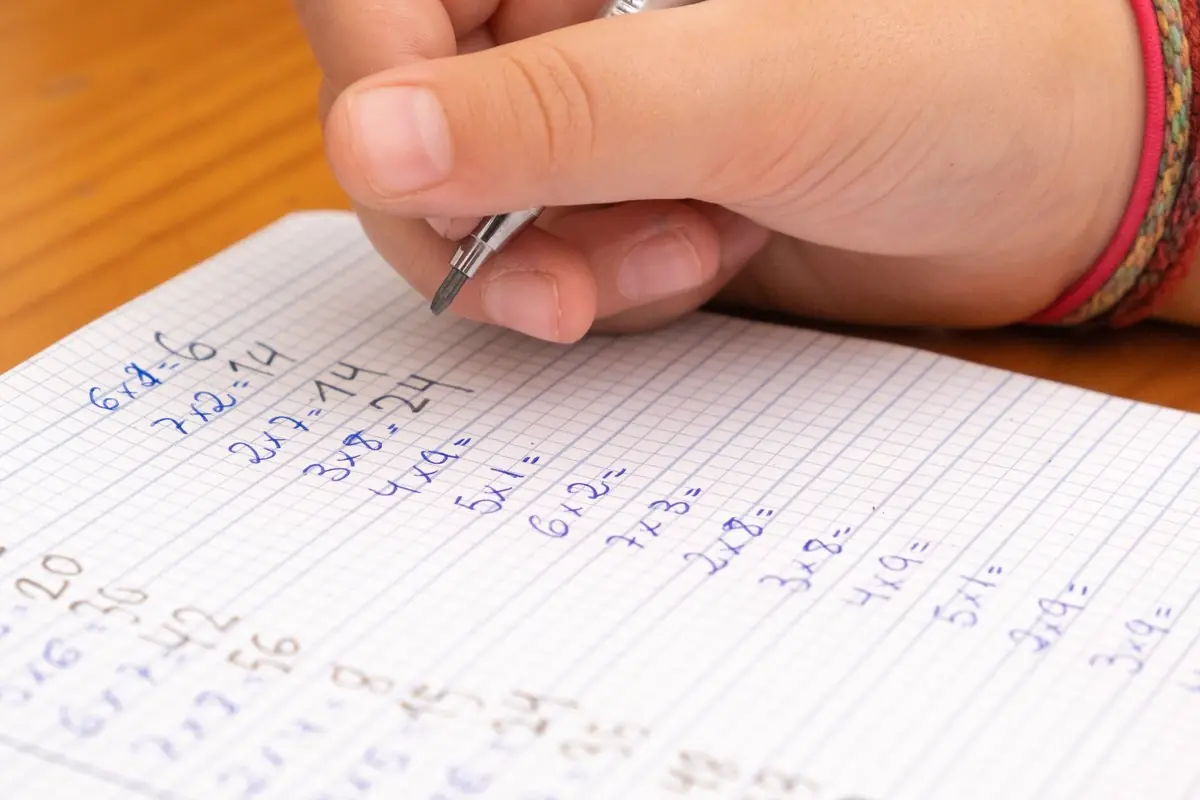
The GCSE maths non-calculator paper tests the same topics as the calculator papers, but it also tests whether your child can carry out the arithmetic by hand, accurately and at speed. Students who do well on it have three things in place: secure written methods for the four operations, fluent fractions and decimals, and the habit of checking answers by estimating. Those are all trainable, which is good news for anyone who dreads Paper 1.
This guide separates out what the non-calculator paper needs, which general revision advice tends to skip.
Key takeaways
- For AQA and Edexcel, Paper 1 is the non-calculator paper: 1 hour 30 minutes and 80 marks, at both Foundation and Higher.
- Choose one written method for multiplication and one for division, and practise them until they are automatic.
- Fractions, decimals, percentages and surds without a calculator are worth a large share of revision time.
- Estimate first, calculate second: a rough answer catches place-value slips.
- Times tables to 12 × 12 and square numbers to 152 save minutes across the paper.
In this guide, we’ll cover:
- What is on the GCSE maths non-calculator paper?
- Written methods for the non-calculator paper
- Fractions without a calculator
- Higher tier: surds, indices and standard form by hand
- Number facts that save time
- Checking answers on the non-calculator paper
- A four-week non-calculator revision plan
- Frequently asked questions
- Build confidence before Paper 1
What is on the GCSE maths non-calculator paper?
For both AQA (8300) and Edexcel (1MA1), students sit three papers of 1 hour 30 minutes, each worth 80 marks. Paper 1 is non-calculator; Papers 2 and 3 allow a calculator. The AQA specification page sets this out, and Edexcel’s structure is the same. The Edexcel specification confirms its Paper 1 is also non-calculator.
Any topic can appear on Paper 1, so it is not a “number paper”. Algebra, geometry, probability and statistics all appear. The difference is that the numbers are chosen to be workable by hand, and examiners expect fully written working.
Written methods for the non-calculator paper
Many marks are lost not on difficult topics but on arithmetic inside easy ones: a correct method for area, then 23 × 17 done wrong. Each student should have one dependable method per operation.
| Operation | Reliable methods | Check |
|---|---|---|
| Addition and subtraction | Column method, lining up decimal points | Inverse operation |
| Multiplication | Grid method or long multiplication (column) | Estimate: 23 × 17 is about 20 × 20 = 400 |
| Division | Short division (bus stop); long division for 2-digit divisors | Multiply back |
| Decimal multiplication | Remove decimals, multiply as integers, put the decimal places back | Count decimal places |
| Decimal division | Multiply both numbers by 10 or 100 until the divisor is whole | Estimate size |
Written multiplication in GCSE
The grid method is slower but harder to get wrong; long multiplication is quicker once secure. Either is fine, provided your child sticks to one. For 3.4 × 0.26, multiply 34 × 26 = 884, then count three decimal places in the question and place them back: 0.884. Estimating 3 × 0.3 = 0.9 confirms it.
Division without a calculator
Short division handles most questions. For 7.56 ÷ 0.4, multiply both by 10 to get 75.6 ÷ 4 = 18.9. Students who panic at decimal divisors usually only need that one rule.
Fractions without a calculator
Fractions appear everywhere on Paper 1: in probability, ratio, algebra and direct questions. The core skills:
- Adding and subtracting: find a common denominator. For mixed numbers, converting to improper fractions first avoids borrowing errors.
- Multiplying: multiply tops and bottoms, cancelling first if possible to keep numbers small.
- Dividing: keep the first fraction, change to multiply, flip the second.
- Fraction of an amount: divide by the bottom, multiply by the top.
- Converting: know the common ones by heart (1/8 = 0.125, 3/8 = 0.375, 1/3 = 0.333…, 1/5 = 0.2).
A quick worked example shows why the improper-fraction route is safer. For 3 1/4 – 1 2/3, convert to 13/4 – 5/3, use the common denominator 12 to get 39/12 – 20/12, and the answer is 19/12, or 1 7/12. Students who try to subtract the whole numbers and fractions separately here have to borrow, and that is where the errors creep in. Ratio questions work the same way: sharing £84 in the ratio 3:4 means 7 parts, so one part is £12 and the shares are £36 and £48. Checking that the shares add back to the total takes a few seconds.
Percentages follow from this. Without a calculator, find 10% and 1% and build: 17.5% of 240 is 24 + 12 + 6 = 42 (10% + 5% + 2.5%).
Higher tier: surds, indices and standard form by hand
Higher students face extra non-calculator demands. Surd simplification (root 48 = 4 root 3), rationalising denominators, fractional and negative indices (27 to the power two-thirds is 9) and standard form multiplication all appear. These are designed for Paper 1 precisely because a calculator would do them instantly. Exact trigonometric values, covered in our GCSE trigonometry guide, belong in the same group.
Number facts that save time
A student who has to work out 7 × 8 every time spends minutes they do not have. Before the exam, make these instant:
- Times tables to 12 × 12
- Square numbers to 152 = 225 and cube numbers to 53 = 125 (and 103)
- Prime numbers to 50
- Powers of 2 to 210 = 1024
- Fraction, decimal and percentage equivalents for halves, quarters, fifths, eighths and tenths
Five minutes of quick recall daily, on the bus or before school, is more useful than an hour once a week.
Checking answers on the non-calculator paper
Without a calculator to confirm results, a checking routine matters more.
- Estimate before calculating. Round each number to one significant figure. If your answer is far from the estimate, rework it.
- Use inverse operations. For a division, multiply back. For a subtraction, add back.
- Sense-check the context. A person 17 metres tall or a probability of 1.3 is a signal.
- Re-read the question. Did it ask for a fraction in simplest form, an answer to 1 decimal place, or units?
Time management matters too: 80 marks in 90 minutes is just over a minute per mark. Our guide to GCSE exam technique and time management explains how to pace the paper and when to move on.
A four-week non-calculator revision plan
- Week 1: diagnose. Do one full Paper 1 untimed, then sort every lost mark into “arithmetic slip”, “method not known” or “misread”.
- Week 2: fix arithmetic. Daily 15-minute drills on the weakest operation, plus number facts.
- Week 3: fractions, percentages and (for Higher) surds and indices, using exam-style questions.
- Week 4: two timed Paper 1s, marked with the mark scheme. Rework every error until it is right.
Starting now gives time for all four weeks before any winter mocks. If time is short, our last-minute GCSE maths revision tips help prioritise.
Frequently asked questions
Which GCSE maths paper is non-calculator?
For AQA and Edexcel, Paper 1 is the non-calculator paper at both Foundation and Higher tier, and Papers 2 and 3 allow a calculator. All three papers can test any part of the specification.
Is the non-calculator paper harder?
Not in content, because every paper draws on the same specification. Many students find it harder because arithmetic slips cost marks and there is no quick way to check. Students with secure written methods and number facts often find it the most predictable of the three papers.
Should I use the grid method or long multiplication at GCSE?
Either is accepted. The grid method breaks numbers into parts and is less error-prone; long multiplication is faster with practice. What matters is choosing one, practising it until it is automatic, and showing the working clearly so method marks are available even if one digit goes wrong.
How can I get faster at mental maths for GCSE?
Short daily practice works best. Drill times tables, squares and fraction-decimal equivalents for five minutes a day, and practise rounding numbers to estimate answers. Speed comes from not having to think about the basic facts, which leaves time for the problem-solving parts of each question.
Do you need to show working on the non-calculator paper?
Yes. Many questions say “you must show your working”, and an unsupported correct answer can score nothing. Even where it is not required, written working earns method marks if the final answer is wrong, so it is always worth setting out each step.
Build confidence before Paper 1
Confidence on the non-calculator paper comes from reliable habits rather than more content. If your child’s lost marks are mostly arithmetic slips, a few weeks of targeted practice can make a real difference. Our GCSE maths tuition in Milton Keynes includes regular non-calculator practice in small groups. To see which skills need work first, book a free assessment.
Next step: Book a free assessment with PrimePlus and we will identify gaps, explain where your child is now and suggest a clear plan. Book your free assessment.