GCSE trigonometry is the set of methods for finding missing sides and angles in triangles. For right-angled triangles you use SOHCAHTOA; for triangles without a right angle you switch to the sine rule or the cosine rule. If your child can label the sides correctly, pick the right ratio and recognise which rule a question is asking for, most trigonometry marks become routine rather than frightening.
This guide takes the topic in the order it is usually taught, from the first right-angled triangle to the Higher-tier rules, so a Year 10 or 11 student can use it as a single revision route.
Key takeaways
- Label the hypotenuse first, then the opposite side from the angle you care about; everything else follows from that.
- SOHCAHTOA only works in right-angled triangles. No right angle means sine rule or cosine rule.
- Exact values of sin and cos for 0, 30, 45, 60 and 90 degrees (and tan for 0 to 60) appear on non-calculator papers and are worth memorising as a small table.
- Use the sine rule when you have an opposite pair (a side and its angle); use the cosine rule when you have three sides, or two sides and the angle between them.
- Check your calculator is in degrees mode before every trig question.
In this guide, we’ll cover:
- What does GCSE trigonometry cover?
- SOHCAHTOA explained: labelling the triangle
- Exact trig values for GCSE: the table worth memorising
- Trigonometry on the non-calculator paper
- When to use the sine rule and the cosine rule
- Common trigonometry mistakes that cost marks
- A two-week trigonometry revision plan
- Frequently asked questions
- Next steps for confident trigonometry
What does GCSE trigonometry cover?
Across the AQA, Edexcel and OCR specifications, trigonometry sits inside the geometry and measures strand. Foundation students are expected to use sine, cosine and tangent in right-angled triangles and to know the exact values of the main angles. Higher students go further: the sine rule, the cosine rule, the area formula (one half ab sin C), and using trigonometry in 3D shapes. The AQA GCSE Mathematics (8300) specification lists these as separate statements and marks which are Higher only.
If your child is not sure which tier they are entered for, that decides how far down this page they need to go. Our guide to GCSE maths Foundation vs Higher explains how the tiers differ.
| Skill | Foundation | Higher |
|---|---|---|
| SOHCAHTOA for sides and angles | Yes | Yes |
| Exact values (0, 30, 45, 60, 90 degrees) | Yes | Yes |
| Sine rule and cosine rule | No | Yes |
| Area = one half ab sin C | No | Yes |
| Trigonometry in 3D shapes | No | Yes |
SOHCAHTOA explained: labelling the triangle
Almost every wrong answer in right-angled trigonometry starts with a wrong label, not a wrong calculation. So start there.
- Hypotenuse (H): the longest side, always opposite the right angle. Label it first because it never moves.
- Opposite (O): the side directly across from the angle you are using (the marked angle or the one you need to find).
- Adjacent (A): the side left over, which touches the angle and is not the hypotenuse.
Then the three ratios:
- SOH: sin x = opposite / hypotenuse
- CAH: cos x = adjacent / hypotenuse
- TOA: tan x = opposite / adjacent
To choose one, tick the two sides involved in the question: the one you know and the one you want. If you have O and H ticked, it is SOH. If A and H, CAH. If O and A, TOA. That small habit stops guessing.
Finding a missing side
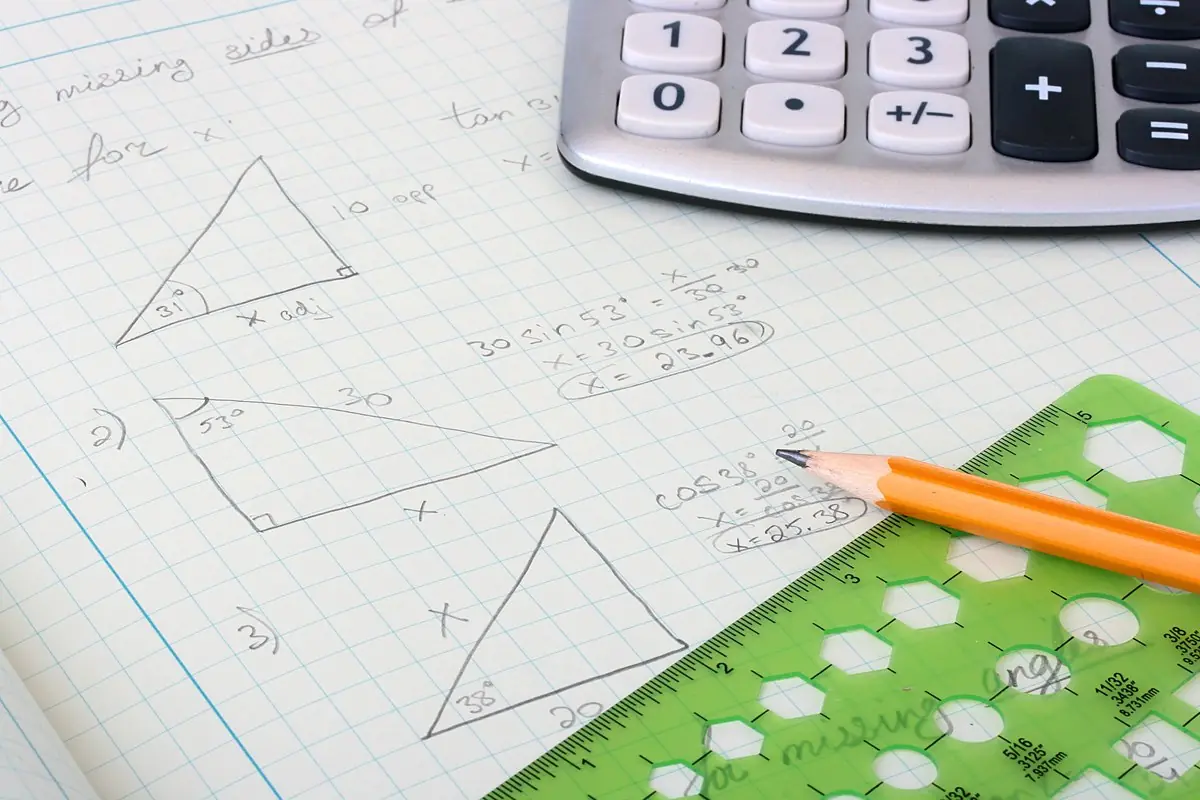
Say the angle is 35 degrees, the hypotenuse is 12 cm and you want the opposite side. O and H are involved, so sin 35 = O / 12. Multiply both sides by 12: O = 12 sin 35, which is about 6.88 cm. If the unknown is on the bottom of the fraction (for example, the hypotenuse is missing), the rearrangement becomes a division instead: H = O / sin x. A formula triangle works for some students, but writing the equation and rearranging is more reliable and carries method marks.
Finding a missing angle
When both sides are known and the angle is missing, write the ratio as a number and use the inverse function. If tan x = 5 / 8, then x = tan-1(5 / 8), which your calculator gives as roughly 32.0 degrees. On most scientific calculators that is SHIFT then the tan key. Practise the inverse key on your own calculator until it is automatic, as it comes up in every angle question.
Exact trig values for GCSE: the table worth memorising
On the non-calculator paper, examiners can ask for the value of sin 30 or tan 45 without a calculator, or build a question around them (for example, a side length expressed as a surd). These exact values come from two triangles: a right-angled isosceles triangle with sides 1, 1 and root 2, and half of an equilateral triangle with sides 1, root 3 and 2.
| Angle | sin | cos | tan |
|---|---|---|---|
| 0 | 0 | 1 | 0 |
| 30 | 1/2 | root 3 / 2 | 1 / root 3 (or root 3 / 3) |
| 45 | root 2 / 2 | root 2 / 2 | 1 |
| 60 | root 3 / 2 | 1/2 | root 3 |
| 90 | 1 | 0 | not defined |
Two patterns make the table easier to hold in memory. First, sin runs up from 0 to 1 while cos runs down from 1 to 0, so the sin column read downwards is the cos column read upwards. Second, the sin values can be written as root 0 / 2, root 1 / 2, root 2 / 2, root 3 / 2, root 4 / 2. A five-minute daily write-out from memory for a fortnight usually fixes it for good.
Trigonometry on the non-calculator paper
Without a calculator, a trig question has to use exact values. A typical style: a right-angled triangle has an angle of 30 degrees and a hypotenuse of 14 cm, so find the opposite side. Since sin 30 = 1/2, the answer is 7 cm. Harder versions combine exact values with surds, such as a length of 6 cos 45, which simplifies to 3 root 2. If your child sees an angle of 30, 45 or 60 on Paper 1, that is the signal to reach for the table. Our guide to GCSE exam technique and time management helps with pacing those papers.
When to use the sine rule and the cosine rule
Once a triangle has no right angle, SOHCAHTOA stops working. Higher students then have two tools. Label the triangle with capital letters A, B, C at the corners and lower-case a, b, c on the opposite sides, so side a faces angle A.
The sine rule
a / sin A = b / sin B = c / sin C. Use it when you know a side and the angle opposite it (an “opposite pair”), plus one more side or angle. To find a side, put the sides on top. To find an angle, flip it so the sines are on top: sin A / a = sin B / b.
The cosine rule
a2 = b2 + c2 – 2bc cos A. Use it when you know two sides and the angle between them (to find the third side), or all three sides (to find an angle). Rearranged for an angle: cos A = (b2 + c2 – a2) / 2bc.
| What you know | What you want | Use |
|---|---|---|
| Right angle plus one side and one angle | Side | SOHCAHTOA |
| Right angle plus two sides | Angle | Inverse SOHCAHTOA (or Pythagoras for a side) |
| A side and its opposite angle, plus one more | Side or angle | Sine rule |
| Two sides and the included angle | Third side | Cosine rule |
| Three sides | Angle | Cosine rule (rearranged) |
| Two sides and the included angle | Area | One half ab sin C |
Whether these formulae are printed for you depends on the exam aid in use. AQA has published the formulae sheets for 2027 and 2028 onwards, and our GCSE maths formula sheet guide explains what is on it. Even with a sheet, students who know the rules well are quicker, and speed matters on a 90-minute paper.
Common trigonometry mistakes that cost marks
- Calculator in the wrong mode. If sin 30 does not give 0.5, the calculator is in radians or gradians. Check before the exam starts.
- Labelling from the wrong angle. Opposite and adjacent swap if you look from the other acute angle. Mark the angle you are using with a dot.
- Using SOHCAHTOA in a non-right-angled triangle. Look for the small square in the corner. No square, no SOHCAHTOA.
- Rounding too early. Keep the full calculator value until the final line, then round to the accuracy asked for (often 1 decimal place or 3 significant figures).
- The ambiguous sine rule case. When finding an angle with the sine rule, a second obtuse answer (180 minus your answer) can sometimes fit. It is worth checking the diagram, because an obtuse angle can also fit.
- Cosine rule order of operations. Students type b2 + c2 – 2bc and then multiply by cos A. Work out the whole 2bc cos A term first, or use brackets.
A two-week trigonometry revision plan
- Days 1 to 3: labelling drills only. Ten triangles a day, mark H, O and A, no calculating.
- Days 4 to 6: missing sides with SOHCAHTOA, including ones where the unknown is the hypotenuse.
- Days 7 and 8: missing angles with inverse functions, and the exact value table from memory.
- Days 9 to 11 (Higher): sine rule and cosine rule, using the decision table above before starting each question.
- Days 12 to 14: mixed past paper questions, including 3D and bearings problems where trigonometry is hidden inside a longer question. Our guide to using past papers well explains how to mark and learn from them.
Frequently asked questions
Is trigonometry on the GCSE maths Foundation paper?
Yes. Foundation students are expected to use sine, cosine and tangent to find sides and angles in right-angled triangles, and to know exact values for common angles. The sine rule, cosine rule and the area formula using sine are Higher only, so Foundation students can leave those out of their revision.
Do you need to memorise exact trig values for GCSE?
It is wise to. Exact values for 0, 30, 45, 60 and 90 degrees are used on non-calculator papers, either asked for directly or built into a longer problem. They are quick to learn from two simple triangles, and a short daily write-out for a couple of weeks usually makes them stick.
How do I know whether to use the sine rule or the cosine rule?
Look for an opposite pair: a side and the angle facing it. If you have one, plus another side or angle, use the sine rule. If you have three sides, or two sides with the angle between them, use the cosine rule. Writing down what you know before choosing avoids most errors.
Why does my calculator give the wrong answer for sin 30?
It is almost certainly set to radians or gradians rather than degrees. Look for a small D, R or G on the display. Change it through the setup menu to degrees, then test with sin 30, which should give exactly 0.5. Do this check at the start of every calculator paper.
Is SOHCAHTOA the same as Pythagoras?
No. Pythagoras links three sides of a right-angled triangle and involves no angles. SOHCAHTOA links two sides with an angle. If a question gives two sides and asks for the third, use Pythagoras. If an angle is given or needed, use trigonometry.
Next steps for confident trigonometry
Trigonometry rewards accurate habits more than talent: label, choose, write the equation, rearrange, then check the mode and rounding. If your child keeps losing marks in the same place, a short assessment will show whether the gap is in labelling, rearranging or choosing the rule. Our GCSE maths tuition in Milton Keynes works on exactly these skills in small groups. To find out where your child stands, book a free assessment.
Next step: Book a free assessment with PrimePlus and we will identify gaps, explain where your child is now and suggest a clear plan. Book your free assessment.