Column subtraction is the written method children use to subtract larger numbers by lining them up in place value columns and working from the ones upwards. When the top digit in a column is too small, they exchange: one ten becomes ten ones, or one hundred becomes ten tens. If you learnt this as “borrowing”, the steps on paper look very similar, but the way schools talk about it is different, and using the same language as your child’s teacher makes homework much smoother.
This guide explains the method as KS2 classrooms teach it, with examples, the trickiest cases and the most common mistakes.
Key takeaways
- Schools call it “exchanging”, not “borrowing”: a ten is swapped for ten ones, so the value of the number does not change.
- The national curriculum introduces formal column subtraction in Year 3 for numbers up to 3 digits, and Year 4 for up to 4 digits.
- Always start in the ones column and work left.
- Zeros in the top number are the hardest case, because the exchange has to come from further along.
- Check every answer by adding it back to the number you subtracted.
In this guide, we’ll cover:
- When do children learn column subtraction?
- Exchanging in subtraction vs borrowing
- Column subtraction step by step
- Subtraction with zeros: the tricky case
- Column subtraction with decimals
- Common column subtraction mistakes
- How to help with subtraction homework at home
- Frequently asked questions
- Build secure written methods
When do children learn column subtraction?
In the national curriculum for mathematics, Year 2 children solve subtraction problems using mental and written methods, but formal columns are not required yet. Year 3 introduces “formal written methods of columnar addition and subtraction” for numbers with up to three digits. In Year 4, this extends to numbers with up to four digits, and in Year 5 to whole numbers with more than four digits.
| Year | What is expected |
|---|---|
| Year 2 | Mental and informal written methods; no formal columns required |
| Year 3 | Formal column subtraction with up to 3 digits |
| Year 4 | Formal column subtraction with up to 4 digits |
| Year 5 | Whole numbers with more than 4 digits, using formal written methods |
Exchanging in subtraction vs borrowing
The marks on the page are almost the same. The difference is in the explanation.
- “Borrowing” suggests you take a number from next door and (in theory) give it back. That idea does not match what is actually happening, which confuses some children.
- “Exchanging” describes it accurately: you swap one ten for ten ones. 52 is still 52 whether you think of it as 5 tens and 2 ones, or 4 tens and 12 ones.
The NCETM, which supports maths teaching in England, uses “exchanging” in its Year 3 column subtraction materials, starting with exchanging from tens to ones and then from hundreds to tens. Using that word at home helps your child connect homework with what they hear in class. For more on how today’s methods differ from what many parents learnt, see our guide to primary maths methods explained for parents.
Column subtraction step by step
Example 1: no exchanging (Year 3)
586 – 243. Write 586 on top, 243 underneath, lined up by place value. Ones: 6 – 3 = 3. Tens: 8 – 4 = 4. Hundreds: 5 – 2 = 3. Answer: 343.
Example 2: one exchange
352 – 127.
- Ones: 2 – 7 cannot be done with whole ones. Exchange one ten from the tens column. Cross out the 5 and write 4; the 2 becomes 12.
- 12 – 7 = 5.
- Tens: 4 – 2 = 2.
- Hundreds: 3 – 1 = 2.
- Answer: 225. Check: 225 + 127 = 352.
Example 3: two exchanges
624 – 358. Ones: 4 – 8 needs an exchange, so the 2 tens become 1 ten and the 4 becomes 14. 14 – 8 = 6. Tens: 1 – 5 also needs an exchange, so the 6 hundreds become 5 and the 1 ten becomes 11. 11 – 5 = 6. Hundreds: 5 – 3 = 2. Answer: 266.
Subtraction with zeros: the tricky case
Numbers like 403 – 168 cause the most errors, because there are no tens to exchange from.
- Ones: 3 – 8 needs an exchange, but the tens column is 0.
- Go to the hundreds: exchange one hundred for ten tens. The 4 becomes 3, and the 0 tens becomes 10.
- Now exchange one of those tens for ten ones. The 10 tens become 9, and the 3 ones become 13.
- Ones: 13 – 8 = 5. Tens: 9 – 6 = 3. Hundreds: 3 – 1 = 2.
- Answer: 235. Check: 235 + 168 = 403.
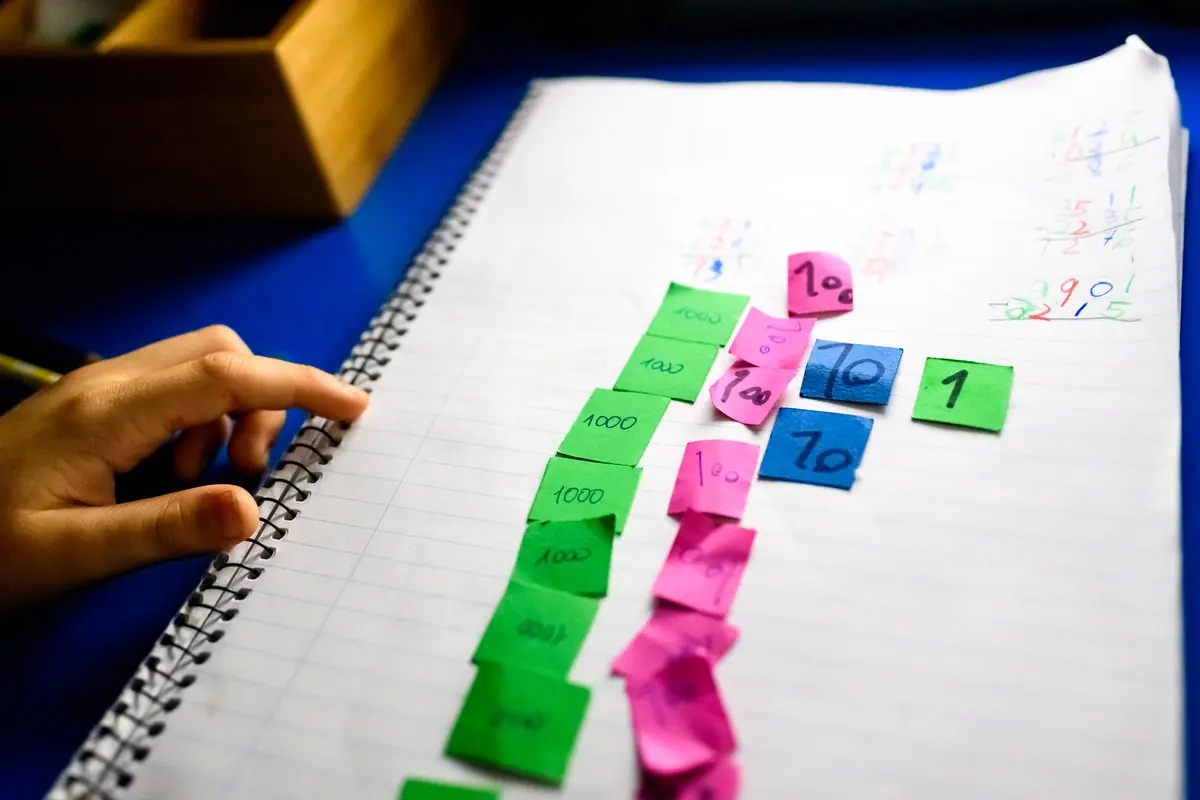
Place value counters or base 10 blocks are the best way to show this. When a child physically swaps a hundred block for ten tens, and then a ten for ten ones, the crossings-out make sense. For a calculation like 2000 – 1998, which would need exchanges across three columns, counting on 2 from 1998 is far quicker, so it is worth asking your child which way suits the numbers.
Column subtraction with decimals
The same method also works with decimals, for example 12.4 – 3.67. The one extra rule is to line up the decimal points, and fill any empty place with a zero so every column has a digit: 12.40 – 3.67. Then subtract exactly as before, from the right. Hundredths: 0 – 7 needs an exchange from the tenths, so the 4 tenths become 3 and the 0 becomes 10, giving 3. Tenths: 3 – 6 needs an exchange from the ones, so 2 becomes 1 and 3 becomes 13, giving 7. Ones: 1 – 3 needs an exchange from the tens, giving 11 – 3 = 8. Tens: 0. The answer is 8.73, and 8.73 + 3.67 = 12.40 confirms it. Money problems, such as working out change, are a natural place to practise this.
Common column subtraction mistakes
| Mistake | Example | Fix |
|---|---|---|
| Subtracting the smaller digit from the larger, whichever is on top | 52 – 27 written as 35 (doing 7 – 2) | Always top minus bottom; if the top is smaller, exchange |
| Exchanging but not reducing the next column | Getting 12 – 7 but leaving the 5 tens as 5 | Cross out and rewrite the digit every time |
| Misaligned columns | Writing 352 – 27 with the 7 under the 5 | Use squared paper, one digit per square |
| Losing track with zeros | 403 – 168 = 345 | Exchange from the hundreds first, then the tens |
| Starting from the left | Working hundreds first, then needing to go back | Always begin with the ones |
How to help with subtraction homework at home
- Use the class words. Say “exchange” and talk about ones, tens and hundreds, not “borrow” or “carry”.
- Ask your child to teach you. Explaining the steps aloud shows you where the understanding breaks down.
- Make it physical. Coins work well: a 10p can be exchanged for ten 1p coins. Try 52p – 27p with real coins.
- Estimate first. 352 – 127 is about 350 – 130 = 220. If the answer is 475, something has gone wrong.
- Always check by adding. Answer plus the number subtracted should give the starting number.
- Keep it short. Five well-checked calculations are better than a page of rushed ones.
Secure column methods also help with the written calculations children meet in Year 6. Our KS2 arithmetic paper tips cover the whole paper.
Frequently asked questions
What is exchanging in subtraction?
Exchanging means swapping one unit from a higher place value column for ten of the next column down, such as one ten for ten ones. It is used when the top digit in a column is smaller than the bottom one. The number’s value stays the same; it is just regrouped so the subtraction can be done.
Why don’t schools call it borrowing any more?
“Borrowing” suggests something is taken and given back, which does not describe what happens. “Exchanging” explains that a ten is regrouped as ten ones, so the value is unchanged. The NCETM’s teaching materials use “exchanging”, and using the same word at home helps children connect homework with lessons.
How do you do column subtraction with zeros?
When you need to exchange but the next column is zero, move further left. Exchange one hundred for ten tens, then exchange one of those tens for ten ones. In 403 – 168, the 4 hundreds become 3, the 0 tens become 9 (after giving one away), and the ones become 13.
What year do children learn column subtraction?
The national curriculum introduces formal column subtraction in Year 3, for numbers with up to three digits. Year 4 extends it to four-digit numbers, and Year 5 to numbers with more than four digits. Before that, in Year 2, children use mental strategies and informal written methods.
How do I check a subtraction answer?
Add the answer to the number you subtracted. If you get back to the starting number, the subtraction is right: for 352 – 127 = 225, check that 225 + 127 = 352. A quick estimate first, such as 350 – 130 = 220, also shows whether the answer is roughly the right size before you check exactly.
Build secure written methods
Column subtraction becomes reliable when children understand the exchange rather than just following steps. If your child keeps getting tangled with zeros or forgets to adjust the next column, a short burst of hands-on practice usually fixes it. Our primary maths and English tuition in Milton Keynes uses concrete resources to secure methods like this. To see where your child is, book a free assessment.
Next step: Book a free assessment with PrimePlus and we will identify gaps, explain where your child is now and suggest a clear plan. Book your free assessment.