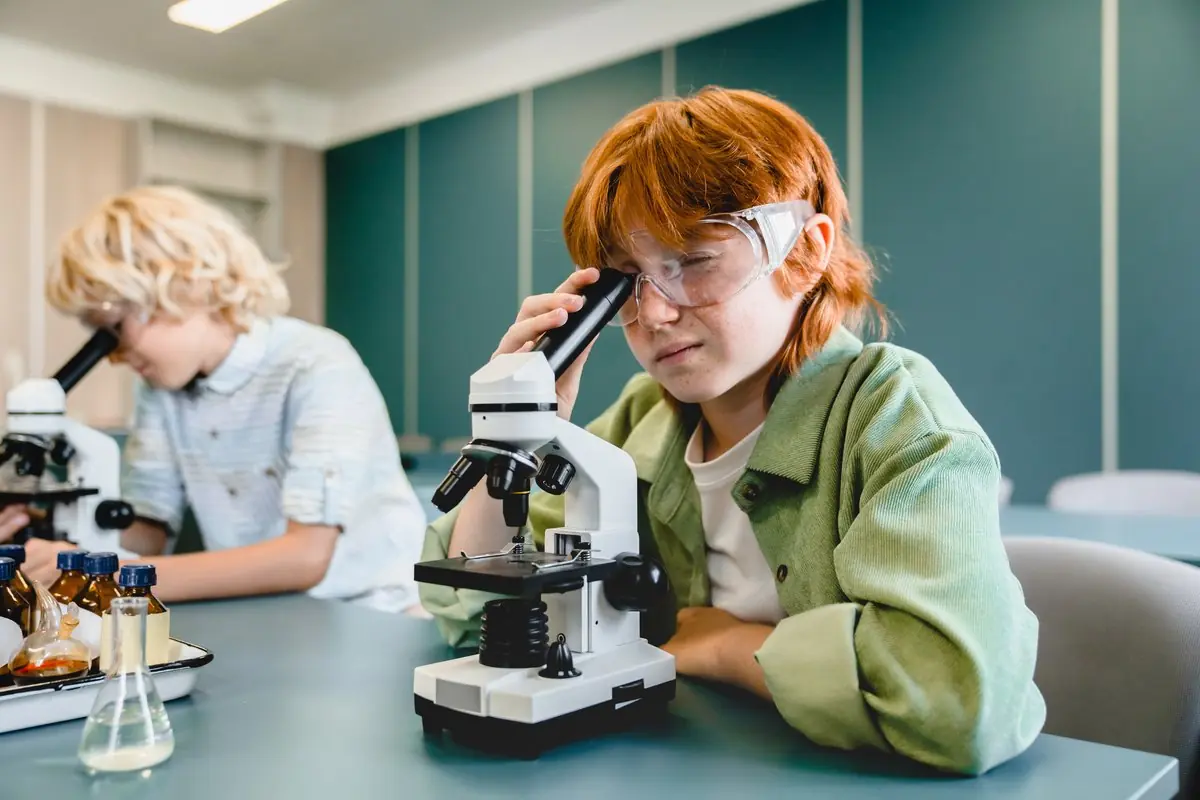
Year 7 science is the start of key stage 3, when children begin learning biology, chemistry and physics as distinct sciences. The national curriculum sets out one programme of study for the whole of key stage 3, covering cells and organisms, particles and chemical reactions, forces, energy, electricity and space, plus the skills of working scientifically. Schools decide which topics to teach in Year 7 and which in Years 8 and 9, so the best way to know exactly what your child is studying is to look at their exercise book or the school’s curriculum page.
Key takeaways
- The KS3 science programme of study is not split by year; each school sets its own order across Years 7 to 9.
- Content covers biology, chemistry and physics, plus “working scientifically”: experiments, measurement, analysis and evaluation.
- Ask the school or check your child’s book to see which topics come first.
- Key vocabulary and simple equations, such as speed from distance and time, are worth practising at home.
- KS3 lays the foundations for GCSE combined or triple science.
In this guide, we’ll cover:
- How KS3 science is organised
- Biology topics in KS3
- Chemistry topics in KS3
- Physics topics in KS3
- Working scientifically: the skills behind the topics
- A worked example: speed, distance and time
- How to support Year 7 science at home
- When your child finds science hard
- Frequently asked questions
- Next steps
How KS3 science is organised
The national curriculum for science sets out programmes of study year by year for key stages 1 and 2, but key stage 3 is presented as a single block. That means there is no national list of “Year 7 topics”. Each secondary school builds its own scheme of work across the three years.
So if a friend’s child at another Milton Keynes school is studying electricity while yours is doing cells, both schools are following the same curriculum in a different order.
Biology topics in KS3
The biology content includes:
- Cells and organisation: similarities and differences between plant and animal cells, and how cells are organised from cells to tissues to organs to systems to organisms.
- The skeletal and muscular systems.
- Nutrition and digestion: including the consequences of imbalances in the diet, such as obesity, starvation and deficiency diseases.
- Gas exchange systems.
- Reproduction: including the structure and function of the human reproductive systems.
- Health, material cycles and energy, interactions and interdependencies, and genetics and evolution.
Cells underpin much of the rest of biology. When your child studies them, they learn the names of cell parts such as the nucleus, cell membrane and, in plant cells, the cell wall and chloroplasts.
Chemistry topics in KS3
- The particulate nature of matter: the properties of solids, liquids and gases explained using the particle model.
- Atoms, elements and compounds: a simple atomic model, chemical symbols and formulae.
- Pure and impure substances: separation techniques including filtration, evaporation, distillation and chromatography.
- Chemical reactions: understanding that reactions involve the rearrangement of atoms.
- Energetics, the periodic table, materials, and earth and atmosphere.
Separating mixtures is easy to picture at home: filtering sand from salty water, then evaporating the water to recover the salt.
Physics topics in KS3
- Energy: energy as a quantity that can be quantified and calculated.
- Motion and forces: including speed and the relationship between average speed, distance and time.
- Waves: starting with waves on water.
- Electricity and electromagnetism: electric current, measured in amperes, and series and parallel circuits.
- Matter: how the arrangement, motion and spacing of particles explain changes of state.
- Space physics: gravity and weight, using weight = mass × gravitational field strength.
The equations are where many students need extra practice. Speed = distance ÷ time is often the first, and it is easy to practise on a car journey or a walk to school.
Working scientifically: the skills behind the topics
Alongside the content, the curriculum sets out “working scientifically”, grouped under four headings:
| Area | What it can look like in lessons |
|---|---|
| Scientific attitudes | Paying attention to objectivity, accuracy, precision, repeatability and reproducibility |
| Experimental skills and investigations | Asking questions, making predictions, planning fair tests, using equipment safely |
| Analysis and evaluation | Drawing tables and graphs, spotting patterns, explaining results, identifying errors |
| Measurement | Using units correctly and carrying out calculations |
These skills carry through to GCSE science. Our guide to GCSE combined versus triple science explains what comes next.
A worked example: speed, distance and time
The speed equation is one of the first calculations many students meet in KS3 physics, and it is a good one to practise together because the numbers can come from real life.
- Write the relationship: average speed = distance ÷ time.
- Pick a real journey: a 3 km walk to school that takes 0.5 hours.
- Substitute: 3 ÷ 0.5 = 6.
- Add the unit: 6 km/h. Without the unit, the answer is incomplete.
- Rearrange: if you know the speed and time, distance = speed × time; if you know the distance and speed, time = distance ÷ speed.
Ask your child to convert the same journey into metres and seconds as a challenge: 3,000 m in 1,800 s gives about 1.7 m/s. Units matter in every science calculation, so practise them each time.
The same pattern elsewhere
Weight = mass × gravitational field strength works in the same way: substitute, calculate, add the unit, and rearrange when needed. Once your child is comfortable with one equation, the method transfers to the others they will meet.
How to support Year 7 science at home
- Ask what they did in the lab. Practicals are memorable. Ask them to explain the method and result, which reinforces the science.
- Build a vocabulary list. Words like particle, diffusion, tissue, current and variable need to be used precisely. Five words a week on a sticky note is enough.
- Practise the equations. Speed, distance and time; weight from mass. Short, real examples work best.
- Draw it. Labelled diagrams of cells, particles in solids, liquids and gases, or a simple circuit help children check understanding.
- Use the kitchen. Melting, dissolving, boiling and separating are all happening while you cook.
- Read the feedback. After a topic test, look at which questions went wrong and why.
Year 7 brings a lot of change at once, from timetables to homework platforms. Our post on starting Year 7 at secondary school covers settling in more broadly.
When your child finds science hard
Start by looking at a recent piece of marked work together. Teacher comments and test scores often show a pattern, such as strong recall of facts but weak explanations, or good ideas let down by units and calculations. Naming the pattern makes the next step obvious.
Science draws on reading and maths. A child who struggles may be finding the vocabulary difficult, or the calculations. Working out which one is the barrier helps you target support:
- If they can explain ideas aloud but write poor answers, work on key words and full-sentence explanations.
- If they understand the ideas but get calculations wrong, practise rearranging simple equations and using units.
- If they cannot explain the ideas at all, go back to diagrams and everyday examples before moving on.
Frequently asked questions
What topics are covered in Year 7 science?
The national curriculum sets out key stage 3 science as one block for Years 7 to 9, so each school chooses which topics come in Year 7. The content includes cells and body systems, particles and chemical reactions, forces, energy, electricity, waves and space. Check your child’s school curriculum page or exercise book for their order.
Is Year 7 science split into biology, chemistry and physics?
The curriculum content is organised under biology, chemistry and physics headings, and your child will cover all three areas across key stage 3. How lessons are arranged is up to each school, so ask if you would like to know how your child’s school does it.
How can I help my child revise for a Year 7 science test?
Find out which topic the test covers, then help your child make a one-page summary with key words, a labelled diagram and any equations. Ask them to explain the summary to you. Short practice questions on the equations and key definitions are more useful than rereading notes.
Does Year 7 science count towards GCSE?
No, Year 7 science does not count towards GCSE grades. But key stage 3 builds the knowledge and practical skills GCSE science assumes, such as the particle model, cell structure and working scientifically. Securing these foundations early makes the step up to GCSE more manageable.
Next steps
This week, ask your child to draw and explain the last thing they studied in science. If they can, praise it; if they cannot, you have found the gap. Our KS3 tuition in Milton Keynes offers small-group and online tuition, and you can book a free assessment to find the right starting point.
Next step: Book a free assessment with PrimePlus and we will identify gaps, explain where your child is now and suggest a clear plan. Book your free assessment.