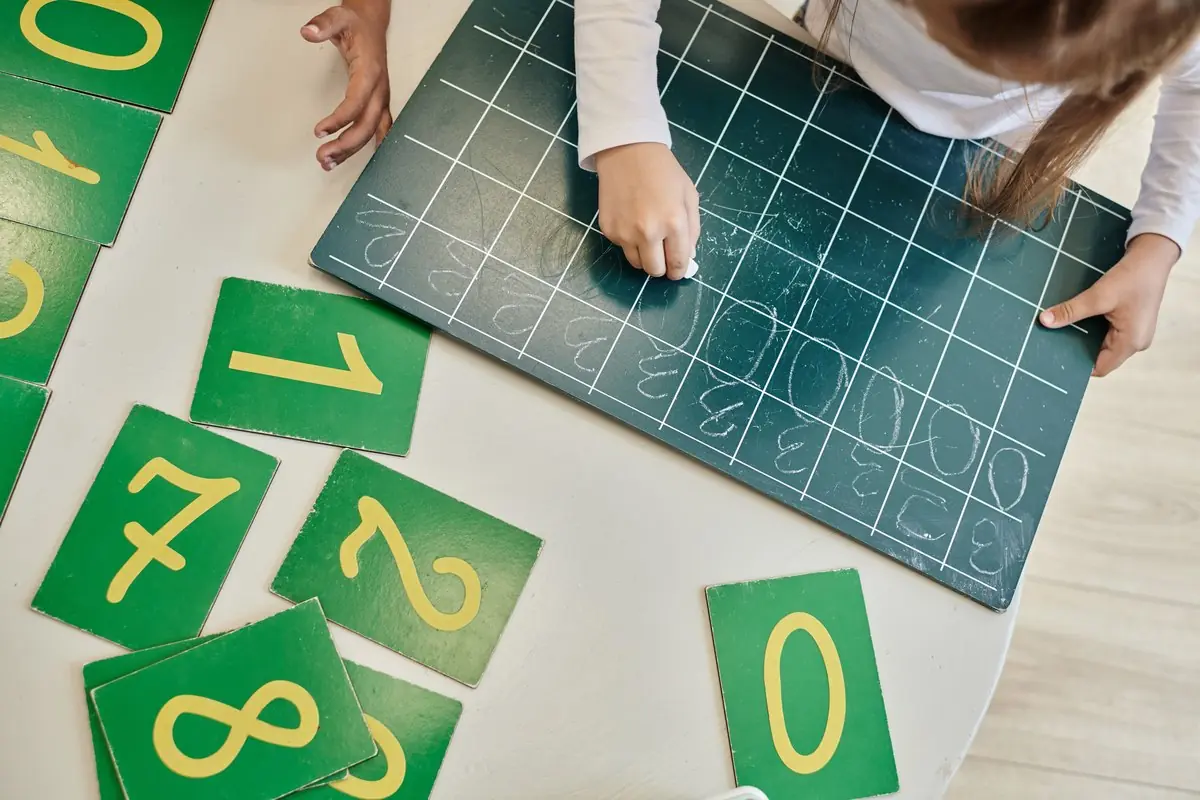
In Year 5 decimals, children extend place value to the right of the decimal point: tenths, hundredths and, for the first time, thousandths. They learn to read, write, order and compare numbers with up to three decimal places, round decimals to the nearest whole number or one decimal place, and connect decimals to fractions they already know. The most helpful thing you can do at home is keep linking decimals to place value columns and to everyday measures like money and length, because that is where the understanding comes from.
Key takeaways
- Year 5 expects children to read, write, order and compare numbers with up to three decimal places.
- Each column to the right of the decimal point is ten times smaller: tenths, hundredths, thousandths.
- A common misconception is that a longer decimal is bigger: 0.35 is smaller than 0.4.
- Rounding to the nearest whole number and to one decimal place are both Year 5 skills.
- Money, measuring and place value charts make decimals concrete.
In this guide, we’ll cover:
- What do children learn about decimals in Year 5?
- Decimal place value: tenths, hundredths and thousandths
- Comparing and ordering decimals
- Rounding decimals in KS2: what Year 5 expects
- Multiplying and dividing decimals by 10, 100 and 1,000
- Common decimal misconceptions
- Activities to help with Year 5 decimals at home
- Frequently asked questions
- Where to start this week
What do children learn about decimals in Year 5?
The national curriculum for mathematics sets out a clear sequence: decimal tenths and hundredths in Year 4, then Year 5 builds on them.
| Year | Decimal content |
|---|---|
| Year 4 | Recognise and write decimal equivalents of tenths and hundredths; round decimals with 1 decimal place to the nearest whole number; compare numbers with the same number of decimal places up to 2 decimal places |
| Year 5 | Read, write, order and compare numbers with up to 3 decimal places; round decimals with 2 decimal places to the nearest whole number and to 1 decimal place; recognise the per cent symbol; multiply and divide whole numbers and decimals by 10, 100 and 1,000 |
| Year 6 | Identify the value of each digit in numbers given to 3 decimal places; multiply one-digit numbers with up to 2 decimal places by whole numbers; use written division where the answer has up to 2 decimal places |
Secure decimal place value in Year 5 gives a firm base for percentages, which Year 5 introduces alongside their fraction and decimal equivalents.
Decimal place value: tenths, hundredths and thousandths
Decimal place value comes back to one idea: each place value column is ten times smaller than the one to its left. Children know this for ones, tens and hundreds. Decimals simply continue the pattern to the right.
| Tens | Ones | . | Tenths | Hundredths | Thousandths |
|---|---|---|---|---|---|
| 2 | 4 | . | 3 | 6 | 5 |
So 24.365 is 2 tens, 4 ones, 3 tenths, 6 hundredths and 5 thousandths. Ask your child to say what each digit is worth: the 6 is worth 6 hundredths, or 0.06.
Children also need to connect decimals to fractions:
- 0.1 = 1/10, 0.01 = 1/100, 0.001 = 1/1000
- 0.5 = 1/2, 0.25 = 1/4, 0.75 = 3/4
- 0.37 = 37/100, which is also 3 tenths and 7 hundredths
If fractions themselves are shaky, our guide to helping with KS2 fractions at home covers the groundwork first.
Comparing and ordering decimals
Comparing decimals is where a common misconception shows up. Some children think 0.35 is bigger than 0.4, because 35 is bigger than 4. They are treating the digits after the point as a whole number.
A method that works
- Line the numbers up by the decimal point, one under the other.
- Fill empty places with zeros so they have the same number of decimal places: 0.35 and 0.40.
- Compare from the left, column by column. In the tenths column, 4 beats 3, so 0.4 is larger.
Order these from smallest to largest: 3.08, 3.8, 3.008, 3.78. Written as 3.080, 3.800, 3.008, 3.780, the order becomes clear: 3.008, 3.08, 3.78, 3.8.
Money helps too. Would you rather have £0.60 or £0.58? Prices give the comparison a context children already know.
Rounding decimals in KS2: what Year 5 expects
Year 5 children round numbers with two decimal places to the nearest whole number and to one decimal place.
To the nearest whole number
Look at the tenths digit. If it is 5 or more, round up; if it is 4 or less, round down. 7.48 rounds to 7; 7.52 rounds to 8.
To one decimal place
Look at the hundredths digit. 4.36 rounds to 4.4, because the 6 hundredths is 5 or more. 4.32 rounds to 4.3.
A number line is the clearest picture. Draw a line from 4.3 to 4.4, mark the halfway point at 4.35, and ask where 4.36 sits. It is past halfway, so closer to 4.4.
Watch for one tricky case: 3.96 to one decimal place is 4.0, because 3.96 is closer to 4.0 than to 3.9. Children should write the zero, because 4.0 shows the answer has been rounded to one decimal place.
Multiplying and dividing decimals by 10, 100 and 1,000
The Year 5 curriculum also asks children to multiply and divide whole numbers and decimals by 10, 100 and 1,000. The rule to teach is that the digits move, not the point. Multiplying by 10 moves every digit one place to the left, so 3.7 × 10 = 37. Multiplying by 100 moves digits two places, so 0.45 × 100 = 45. Dividing moves them to the right: 52 ÷ 100 = 0.52 and 6 ÷ 1,000 = 0.006.
A place value chart makes this visible. Write the digits in the columns, then physically slide the digit cards along while the point stays still. Empty places at the start need a zero as a placeholder, which is why 6 ÷ 1,000 is written 0.006.
Common decimal misconceptions
| What the child thinks | Why it happens | How to fix it |
|---|---|---|
| 0.25 > 0.7 | Reading the decimal part as a whole number | Compare tenths first: 7 tenths is more than 2 tenths |
| 0.3 means a third | Confusing the digit 3 with the fraction 1/3 | 0.3 is three tenths; 1/3 is about 0.333 |
| 2.5 × 10 = 2.50 | Learning “add a zero” for multiplying by 10 | Digits move one place left: 25 |
| The point is a separator, like a full stop | Money notation, where pounds and pence feel like separate numbers | Use a place value chart showing the point between ones and tenths |
| Thousandths are bigger than hundredths | “Thousand” sounds bigger than “hundred” | Cut a strip into 10, then one tenth into 10 again: each new piece is smaller |
Our post on primary maths methods explained for parents covers the written methods children meet in primary school.
Activities to help with Year 5 decimals at home
- Shop receipts. Read prices aloud correctly: “four pounds thirty-five” and also “four point three five”. Order items by price.
- Measure and record. Measure heights in metres to two decimal places (1.42 m) and compare family members.
- Digit card challenge. Give your child four digit cards and a decimal point. Make the biggest and smallest numbers possible with two decimal places.
- Race results. Look up times from a swimming or athletics event, where hundredths of a second decide the winner. Put them in order.
- Kitchen scales. Weigh ingredients in kilograms. 0.25 kg of flour is 250 g, a quarter of a kilogram.
Keep each activity short and conversational. Asking “how do you know?” after each answer makes your child explain the place value behind it.
Frequently asked questions
Why does my child find decimals harder than fractions?
Decimals look like whole numbers, so children apply whole-number rules that no longer work, such as thinking more digits means a bigger number. Linking every decimal back to a place value column, and to the matching fraction, helps clear the confusion.
How do you explain thousandths to a child?
Use a metre stick. One metre split into ten gives tenths (10 cm each), into a hundred gives hundredths (1 cm each), and into a thousand gives thousandths (1 mm each). A millimetre being a thousandth of a metre shows how small each new column is.
How do Year 5 decimals lead into Year 6?
Year 6 builds directly on Year 5 decimals. Children identify the value of each digit in numbers given to three decimal places, multiply one-digit numbers with up to two decimal places by whole numbers, and use written division where the answer has up to two decimal places. A child who is confident with Year 5 place value finds that Year 6 work far easier to follow.
Should my child say “point thirty-five” or “point three five”?
“Point three five” is correct. Each digit after the decimal point is read separately, because each represents a different place value: three tenths and five hundredths. Saying “point thirty-five” reinforces the misconception that the decimal part is a whole number, so gently correct it.
Where to start this week
Draw a place value chart with your child and put in three prices from your last shopping trip. Then ask which is biggest and how they know. If decimals or place value are causing ongoing trouble, our primary maths and English tuition in Milton Keynes offers small-group and online tuition, and you can book a free assessment to see exactly where to focus.
Next step: Book a free assessment with PrimePlus and we will identify gaps, explain where your child is now and suggest a clear plan. Book your free assessment.