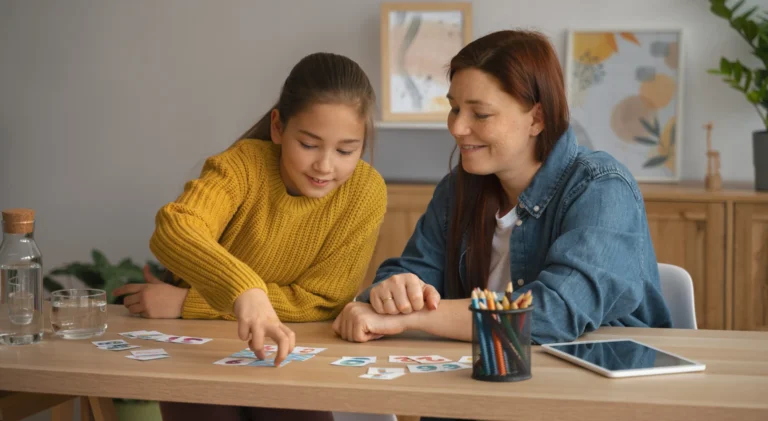
Sparx Maths homework is set online and adapts to each student, but it expects them to work on paper and keep a record of every answer. The best help a parent can give is not explaining each question, but making sure your child writes the bookwork code and working for every question, uses the support videos before asking for help, and gets the homework started early in the week. Those three habits solve most Sparx arguments at home.
This guide explains how the platform works and where KS3 students tend to get stuck, so you can support without doing it for them.
Key takeaways
- Every Sparx question has a bookwork code, and students should write it next to their working on paper.
- A bookwork check asks for the answer to a question your child got right in the last hour, so working must be written down as they go.
- Failing a check means redoing the question, which is why “I did it but it says I’m wrong” is so common.
- Help by asking questions and pointing to the built-in video, not by giving the answer.
- Start homework early in the week so there is time to ask the teacher about anything genuinely stuck.
In this guide, we’ll cover:
- How does Sparx Maths homework work?
- What are Sparx bookwork codes?
- Why students get stuck on Sparx homework
- How parents can help with Sparx maths without doing it
- When to talk to the maths teacher
- Frequently asked questions
- Support that builds independence
How does Sparx Maths homework work?
Sparx Maths is an online homework platform used by secondary schools. The teacher sets a weekly homework, and the platform chooses questions matched to the topics being taught and to your child’s past performance. Two students in the same class may see different questions.
Sparx’s guide to the key concepts of a Sparx Maths homework describes three parts:
| Part | What it is | Usually expected? |
|---|---|---|
| Compulsory | The main weekly homework; every question must be answered correctly for it to count as complete | Yes |
| XP Boost | Extra practice, mainly revisiting earlier homework topics | Optional |
| Target | Up to six harder questions to stretch students | Optional |
Each question also has a support video showing the skill needed, and students can swap up to three questions for alternatives after watching a video for at least 15 seconds.
What are Sparx bookwork codes?
Each question shows a short code such as 2C. The number refers to the task and the letter to the question within it. Students are expected to write that code in their exercise book, followed by the working and the answer.
Every so often, the platform runs a bookwork check. According to Sparx’s own support guidance, the check shows only the code of a question your child answered correctly within the last hour and asks them to pick the answer they got. Students who pass checks consistently get fewer of them; those who struggle get more. Checks are not used during Independent Learning, they do not cross between homework types, and they cannot be switched off for a whole school.
The purpose is simple: to make sure students work things out on paper rather than guessing or using a calculator app with no working. Done properly, the written record is also a useful revision resource.
A good bookwork layout
- Write the date and the homework title at the top of the page.
- For each question, write the bookwork code in the margin.
- Show the working underneath, even for short questions.
- Box or underline the final answer, so it is easy to find in a check.
Why students get stuck on Sparx homework
Most frustration falls into a few patterns. Knowing which one your child is in helps you respond calmly.
- Failed bookwork checks. If the answer was not written down, or was written without the code, a check becomes a memory test. The fix is the layout above.
- Compulsory not finishing. Because every Compulsory question needs to be correct, one wrong answer keeps it open. Your child needs to rework that question, often after watching the support video.
- Rushing. Typing an answer quickly to “get through” usually leads to more wrong answers and more checks.
- Answer format. Fractions, units, rounding or negative signs entered in the wrong format are marked wrong. Read the instruction under each question carefully.
- A genuine gap. Sometimes the topic itself has not clicked. That is worth telling the teacher about, as it shows them exactly what to revisit.
How parents can help with Sparx maths without doing it
You do not need to know the maths to help. Your role is coach rather than tutor.
Questions to ask instead of answers to give
- “What is the question actually asking for?”
- “Have you watched the video for this one?”
- “Can you show me your working? Where did it start going differently?”
- “Is there a similar question in your book from last week?”
- “Does that answer seem a sensible size?”
Practical support that makes a difference
- A fixed slot. Agree a regular time early in the week, for example Monday or Tuesday evening, so homework is not left until the night before the deadline. Our post on after-school routines and homework battles has ideas for making that stick.
- The right kit. An exercise book, a pencil, a ruler and a scientific calculator if the questions allow it.
- Quiet focus. Phone in another room for the session. Sparx works best in one sitting of 30 to 60 minutes rather than scattered attempts.
- Look at the book, not the screen. A quick glance at the written working each week tells you more than the completion percentage.
What to avoid: typing answers in for your child, looking up answers online, or doing the working for them. These cause more bookwork check failures, and they hide gaps the teacher needs to see.
Using the exercise book for revision
A well-kept Sparx book becomes a record of every topic your child has practised this year. Before a test or end-of-year exam, they can flick back, pick five questions from earlier weeks and try them again on a fresh page without looking at the original working. Any they cannot do show exactly what to revise. That turns weekly homework into retrieval practice, which is one of the most effective ways to make maths stick.
When to talk to the maths teacher
Contact school if your child regularly spends much longer than expected on Compulsory homework, cannot complete it even after watching the videos, or becomes very anxious about it. Teachers can see detailed data on which questions caused trouble and can adjust the work. If your child has additional needs that make the checks difficult, the school can raise this with Sparx.
A pattern of struggling with the same topics is also a signal. In Year 8 especially, some students lose confidence in maths; our post on the Year 8 dip in KS3 explains why and what helps.
Frequently asked questions
What is a bookwork check on Sparx Maths?
A bookwork check asks your child to choose the answer to a question they answered correctly in the last hour, shown only by its bookwork code. It checks that they are writing their working down. Writing the code, working and answer for every question in an exercise book makes checks quick to pass.
What happens if you fail a Sparx bookwork check?
The question has to be answered again, even if the original answer was correct. Students who fail checks often get more of them. The fix is almost always better note-taking: writing each bookwork code with its working and a clearly marked answer, so it can be found in seconds.
How long should Sparx Maths homework take?
Each school sets its own expectation, so check your child’s homework policy or ask the maths department. If Compulsory homework regularly takes far longer than the school expects, tell the teacher. They can see which questions caused delays and may adjust the work or revisit a topic in class.
Is Sparx Target homework compulsory?
No. Sparx describes XP Boost and Target as optional, while Compulsory homework must be completed with every question correct. Target has up to six harder questions designed to stretch students, so it is useful practice for confident students who want a challenge.
Can parents see their child’s Sparx homework?
Schools handle this differently. You can always ask your child to show you their account and exercise book. The written book is often the most revealing, as it shows whether working is set out clearly and where errors happen.
Support that builds independence
Sparx is designed to make students do the thinking themselves, so the best help keeps it that way: a regular slot, a tidy bookwork layout and good questions from you. If your child keeps getting stuck on the same topics, extra support can fill the gap before it widens. Our online tuition and small-group KS3 maths sessions in Milton Keynes work on exactly those topics. To find where the gaps are, book a free assessment.
Next step: Book a free assessment with PrimePlus and we will identify gaps, explain where your child is now and suggest a clear plan. Book your free assessment.