KS2 angles build up step by step. Children first meet angles as turns and right angles, then learn to compare angles with a right angle, name acute and obtuse angles, measure and draw angles in degrees, and finally use angle facts to find missing angles. By Year 6 the national curriculum expects pupils to recognise angles that meet at a point, lie on a straight line or are vertically opposite, and to find missing angles. The key facts are: a right angle is 90°, angles on a straight line add up to 180°, and angles at a point add up to 360°.
Key takeaways
- Year 3: angles as turns and as a property of shape; right angles; greater or less than a right angle.
- Year 4: identify acute and obtuse angles and order angles up to 2 right angles.
- Year 5: measure and draw angles in degrees; estimate acute, obtuse and reflex angles; 360° at a point, 180° on a straight line.
- Year 6: find missing angles at a point, on a straight line and vertically opposite.
- Estimate first, then measure: it catches reading the wrong protractor scale.
In this guide, we’ll cover:
- What the national curriculum expects
- Angles as turns
- Types of angles
- Measuring angles with a protractor
- Angle facts for finding missing angles
- Practising angles at home
- Frequently asked questions
- Next steps
What the national curriculum expects
The national curriculum for mathematics introduces angles gradually:
| Year | Statutory statements on angles |
|---|---|
| Year 2 | Rotation as a turn in terms of right angles for quarter, half and three-quarter turns (clockwise and anti-clockwise) |
| Year 3 | Recognise angles as a property of shape or a description of a turn; identify right angles, recognise that 2 right angles make a half-turn; identify whether angles are greater than or less than a right angle |
| Year 4 | Identify acute and obtuse angles and compare and order angles up to 2 right angles by size |
| Year 5 | Know angles are measured in degrees: estimate and compare acute, obtuse and reflex angles; draw given angles and measure them in degrees; angles at a point and 1 whole turn (total 360°); angles at a point on a straight line and half a turn (total 180°); other multiples of 90° |
| Year 6 | Recognise angles where they meet at a point, are on a straight line, or are vertically opposite, and find missing angles; draw 2-D shapes using given dimensions and angles |
The protractor appears in the non-statutory guidance: Year 4 compares and orders angles “in preparation for using a protractor”, and the Year 5 notes mention “measuring with a protractor”.
Angles as turns
Before degrees, children describe angles as amounts of turn. A quarter turn is one right angle, a half turn is two right angles and a full turn is four. Practise with your child standing up: “Make a quarter turn clockwise. Now a half turn anti-clockwise. Which way are you facing?” Clock hands are also a good model: from 12 to 3 is a quarter turn.
Types of angles
| Type | Size | How to spot it |
|---|---|---|
| Acute | Less than 90° | Smaller than the corner of a page |
| Right angle | Exactly 90° | Fits the corner of a page; marked with a small square |
| Obtuse | More than 90° but less than 180° | Wider than a right angle but not a straight line |
| Straight line | Exactly 180° | Two right angles; a half turn |
| Reflex | More than 180° but less than 360° | Bigger than a straight line; the “outside” of an angle |
A folded piece of paper makes a handy right-angle checker. Fold any sheet once, then fold it again so the first crease lies exactly on top of itself; the new folded corner is a right angle. Hold it in the corner of an angle: if the angle is smaller, it is acute; if bigger, obtuse.
Measuring angles with a protractor
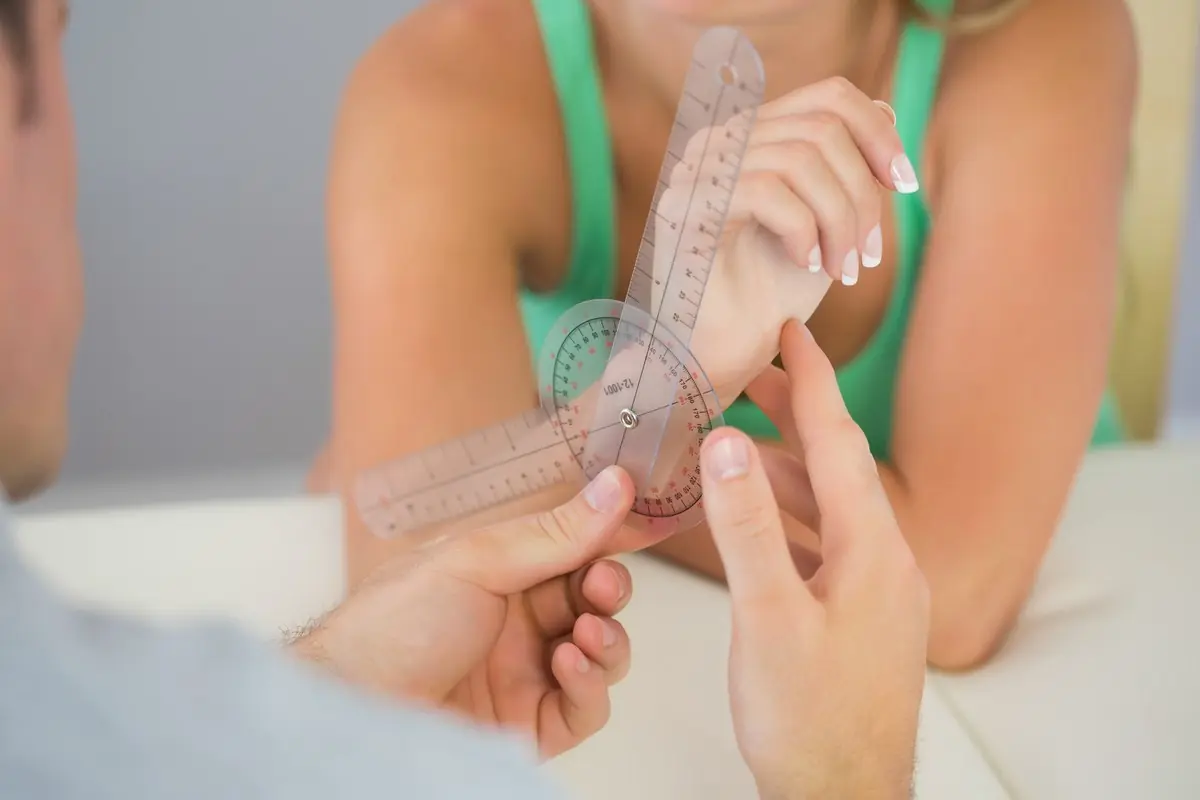
A protractor has two scales running in opposite directions. Follow these steps:
- Estimate first. Is the angle acute or obtuse? Roughly how big?
- Place the centre of the protractor (the small cross or hole) exactly on the point where the two lines meet.
- Line up zero: turn the protractor so that its baseline lies along one arm of the angle.
- Choose the scale that starts at 0 on that arm.
- Read where the other arm crosses that scale, counting up from 0.
- Check against your estimate. If you estimated acute and read 130°, you used the wrong scale; the answer is 50°.
If an arm is too short to reach the scale, extend it with a ruler before measuring.
Measuring reflex angles
A standard semicircular protractor goes to 180°. To measure a reflex angle, measure the smaller angle inside it and subtract from 360°. If the inside angle is 70°, the reflex angle is 360° − 70° = 290°.
Drawing an angle
- Draw a straight line with a ruler and mark a point at one end.
- Place the protractor’s centre on the point, with zero along the line.
- Count up the correct scale from 0 and make a small dot at the angle you need.
- Remove the protractor and join the point to the dot with a ruler. Label the angle.
Angle facts for finding missing angles
Angles on a straight line add up to 180°
If two angles sit together on a straight line and one is 125°, the other is 180° − 125° = 55°.
Angles at a point add up to 360°
If three angles meet at a point and two are 140° and 95°, the third is 360° − 140° − 95° = 125°.
Vertically opposite angles are equal
When two straight lines cross, they make an X shape. The angles opposite each other are equal. If one angle is 40°, the angle opposite is also 40°, and the two others are each 180° − 40° = 140°.
Worked example: a multi-step question
Two straight lines cross. One of the angles is 65°. Find the other three.
- The angle vertically opposite 65° is also 65°.
- The angle next to 65° on the straight line is 180° − 65° = 115°.
- The angle opposite that is also 115°.
- Check: 65 + 115 + 65 + 115 = 360°, which matches angles at a point.
Writing which fact you used for each step makes the answer easy to check. A quick sketch helps too: label the angles you know, mark the one you need with a letter, then write the fact that links them before doing any subtraction.
Practising angles at home
- Angle hunt: find acute, right, obtuse and reflex angles around the house, such as a slightly open door, a book corner or scissors.
- Clock angles: what type of angle do the hands make at 2 o’clock, 3 o’clock and 5 o’clock? (Acute, right, obtuse.)
- Estimate and measure: draw angles for each other, estimate, then measure with a protractor.
- Turn instructions: give directions using quarter and half turns, clockwise and anti-clockwise.
- Missing angle puzzles: draw a straight line split into two angles, label one and ask for the other.
Our post on primary maths methods explained for parents covers other areas of KS2 maths, and our guide to KS2 arithmetic paper tips supports the subtraction used in missing-angle questions.
Frequently asked questions
When do children learn to measure angles?
In the national curriculum, Year 5 pupils learn that angles are measured in degrees and are taught to draw given angles and measure them in degrees. The Year 4 non-statutory guidance prepares for using a protractor by comparing and ordering angles.
What is a reflex angle?
A reflex angle is more than 180° but less than 360°. To measure one with a standard protractor, measure the smaller angle and subtract it from 360°. Reflex angles appear in the Year 5 curriculum alongside acute and obtuse angles.
Why does my child get the wrong reading on a protractor?
A standard protractor has two scales running in opposite directions. Reading the wrong one gives the angle’s partner to 180°, such as 130° instead of 50°. Estimating first, and starting from the 0 that lies on one arm, fixes this.
What angle facts are needed in Year 6?
The Year 6 curriculum asks pupils to recognise angles that meet at a point, are on a straight line, or are vertically opposite, and to find missing angles. The facts behind this are: angles at a point total 360°, angles on a straight line total 180°, and vertically opposite angles are equal.
Next steps
Try an angle hunt and a clock-angle quiz this week, then practise measuring three angles with a protractor, estimating each one first. If geometry or other maths topics are a worry, our primary maths and English tuition in Milton Keynes offers small-group and online tuition, and a free assessment shows where your child is.
Next step: Book a free assessment with PrimePlus and we will identify gaps, explain where your child is now and suggest a clear plan. Book your free assessment.