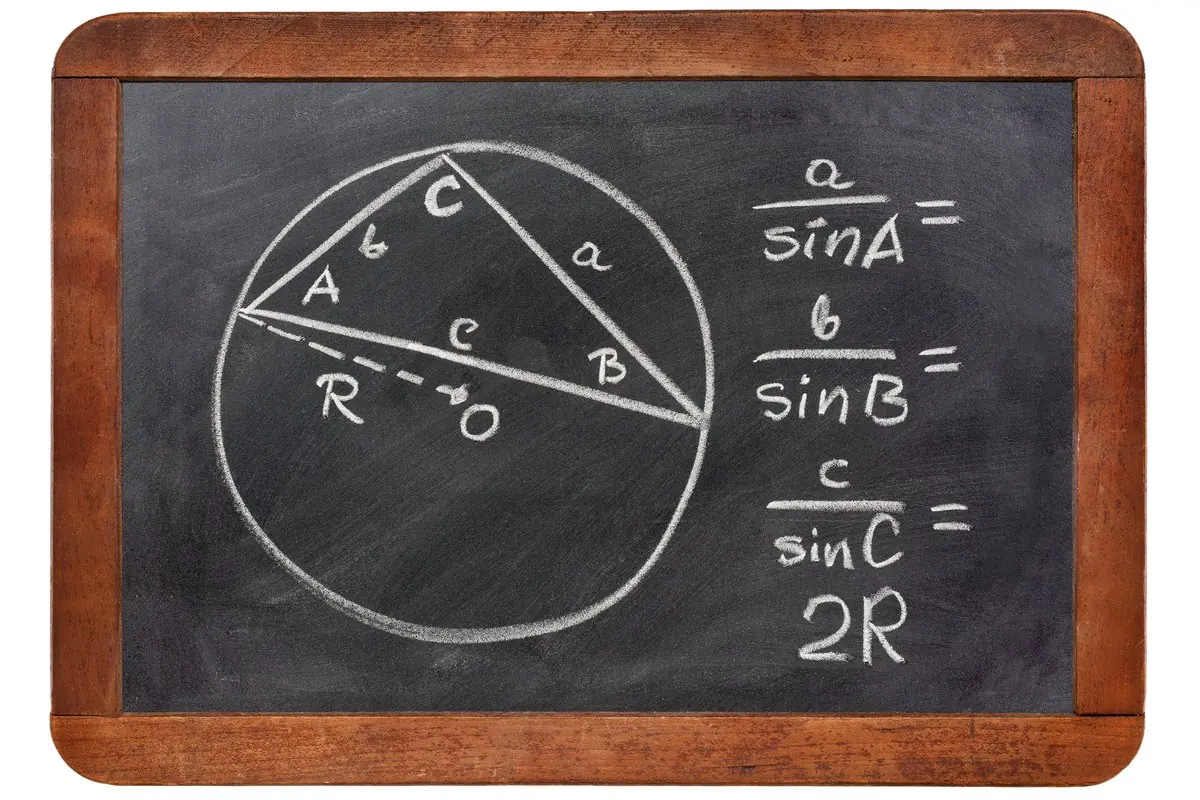
This guide groups the circle theorems GCSE asks for into eight rules about the angles formed by radii, chords and tangents in a circle. The angle at the centre is twice the angle at the circumference. The angle in a semicircle is 90°. Angles in the same segment are equal. Opposite angles of a cyclic quadrilateral add to 180°. A tangent meets a radius at 90°. Two tangents from a point are equal in length. The perpendicular from the centre to a chord bisects it. And the alternate segment theorem links the angle between a tangent and a chord to the angle in the opposite segment. In answers, each angle you find needs a reason written in words.
Key takeaways
- The DfE’s GCSE content asks students to apply and prove the standard circle theorems concerning angles, radii, tangents and chords.
- Learn each theorem as a picture as well as a sentence, so you can spot it in a diagram.
- Write a reason in words for every angle you find, using the theorem’s name.
- Look for radii first: two radii make an isosceles triangle.
- Basic angle facts, such as angles in a triangle adding to 180°, are used alongside the theorems.
In this guide, we’ll cover:
- What GCSE maths asks for
- The eight circle theorems
- Quick reference table
- Writing reasons clearly
- Worked example
- Proving a circle theorem
- Tips for remembering the theorems
- Frequently asked questions
- Next steps
What GCSE maths asks for
The Department for Education’s GCSE mathematics subject content includes the statement “apply and prove the standard circle theorems concerning angles, radii, tangents and chords, and use them to prove related results”. So you need to use the theorems to find angles, and also be ready to explain or prove why they are true. Our guide to Foundation versus Higher GCSE maths explains how content is split between the tiers.
First, the vocabulary:
- Radius: a line from the centre to the circumference.
- Chord: a straight line joining two points on the circumference.
- Tangent: a straight line that touches the circle at exactly one point.
- Segment: the region between a chord and the arc it cuts off.
- Cyclic quadrilateral: a four-sided shape with all four corners on the circumference.
- Subtended: an angle “subtended by an arc” is the angle made at a point by lines from the two ends of that arc.
The eight circle theorems
1. The angle at the centre is twice the angle at the circumference
Lines from the two ends of an arc meet at the centre and at a point on the circumference. The angle at the centre is double the angle at the circumference. Picture an arrowhead shape: the tip of the arrow is on the circumference, and the angle at the centre, inside the arrowhead, is twice as big.
Reason to write: “The angle at the centre is twice the angle at the circumference.”
2. The angle in a semicircle is 90°
If a triangle is drawn with one side as a diameter and the third corner on the circumference, the angle at that corner is a right angle. This is a special case of theorem 1: the angle at the centre is a straight line, 180°, so the angle at the circumference is 90°.
Reason to write: “The angle in a semicircle is 90°.”
3. Angles in the same segment are equal
Angles at the circumference subtended by the same chord or arc, and on the same side of it, are equal. Picture a “bow tie” or butterfly shape with both points on the circumference.
Reason to write: “Angles in the same segment are equal.”
4. Opposite angles of a cyclic quadrilateral add up to 180°
If all four corners of a quadrilateral lie on the circle, each pair of opposite angles sums to 180°. Check that all four corners really are on the circumference: if one is at the centre, it is not a cyclic quadrilateral.
Reason to write: “Opposite angles of a cyclic quadrilateral add up to 180°.”
5. A tangent meets a radius at 90°
The radius drawn to the point where a tangent touches the circle is perpendicular to the tangent.
Reason to write: “The angle between a tangent and a radius is 90°.”
6. Tangents from an external point are equal in length
From a point outside the circle, two tangents can be drawn. They are equal in length. Together with the two radii, they make a kite shape, which often leads to an isosceles triangle or angle work.
Reason to write: “Tangents from an external point are equal in length.”
7. The perpendicular from the centre to a chord bisects the chord
A line from the centre that meets a chord at a right angle cuts the chord into two equal halves. The reverse is also true: a line from the centre to the midpoint of a chord is perpendicular to it. This often sets up a right-angled triangle for Pythagoras’ theorem.
Reason to write: “The perpendicular from the centre to a chord bisects the chord.”
8. The alternate segment theorem
The angle between a tangent and a chord is equal to the angle in the alternate segment: the angle at the circumference subtended by that chord, on the other side of it. It can be the hardest one to spot. Look for a tangent, a chord from the point of contact, and a triangle inside the circle using that chord.
Reason to write: “The alternate segment theorem.”
Quick reference table
| Look for | Theorem |
|---|---|
| An angle at the centre and one at the edge from the same arc | Centre is twice the circumference |
| A triangle with a diameter as one side | Angle in a semicircle is 90° |
| A bow-tie shape | Angles in the same segment are equal |
| Four corners on the circle | Cyclic quadrilateral: opposites add to 180° |
| A tangent touching where a radius ends | Tangent and radius meet at 90° |
| Two tangents from one point | Tangents are equal in length |
| A line from the centre at right angles to a chord | It bisects the chord |
| A tangent and a chord from the point of contact | Alternate segment theorem |
Writing reasons clearly
Each angle you find needs a reason, because the DfE content asks you to apply and prove the theorems. A number alone does not show how you got it. Good practice:
- One step per line: state the angle, its value, and the reason.
- Use the theorem’s full wording, such as “opposite angles of a cyclic quadrilateral add up to 180°”, not “cyclic quad”.
- Include basic angle facts too: “angles in a triangle add up to 180°”, “base angles of an isosceles triangle are equal”, “angles on a straight line add up to 180°”.
- Name angles with three letters, such as angle ABC, so it is clear which one you mean.
Worked example
Points A, B, C and D lie on a circle with centre O. Angle ABC = 65°. Find angle AOC (the angle at the centre on the same arc) and angle ADC, where D is on the opposite side of the circle from B, so ABCD is a cyclic quadrilateral.
- Angle AOC = 2 × 65° = 130°. Reason: the angle at the centre is twice the angle at the circumference.
- Angle ADC = 180° − 65° = 115°. Reason: opposite angles of a cyclic quadrilateral add up to 180°.
Then check: triangle AOC has OA = OC (both radii), so it is isosceles, and its base angles are each (180° − 130°) ÷ 2 = 25°. Spotting radii and isosceles triangles like this can unlock a harder question.
A second example with a tangent
A tangent touches a circle with centre O at point P. A point T lies on the tangent, and angle OTP = 32°. Find angle POT.
- Angle OPT = 90°. Reason: the angle between a tangent and a radius is 90°.
- Angle POT = 180° − 90° − 32° = 58°. Reason: angles in a triangle add up to 180°.
Proving a circle theorem
Because the subject content says “apply and prove”, it helps to know how one proof works. For theorem 1, draw the radius from the centre O to the point on the circumference, C. This splits the shape into two isosceles triangles, each with two radii as sides. In each triangle, the two base angles are equal, say x and y. The exterior angles at O are then 2x and 2y, so the angle at the centre is 2x + 2y = 2(x + y), which is twice the angle at the circumference, x + y. Working through this proof once makes the theorem easier to remember.
Tips for remembering the theorems
- Draw each theorem from memory on a blank page, then label it.
- Make flashcards: picture on one side, reason on the other.
- Practise “spot the theorem” with diagrams before working out any angles.
- Keep a list of basic angle facts beside the theorems; many questions use both.
Our post on the GCSE maths formula sheet covers what else to learn by heart.
Frequently asked questions
How many circle theorems are there at GCSE?
The DfE subject content does not give a number. It says students should apply and prove the standard circle theorems concerning angles, radii, tangents and chords. This guide groups those results into eight rules, which together cover the angle, tangent and chord facts usually taught at GCSE.
Do I need to prove circle theorems?
The DfE subject content asks students to “apply and prove the standard circle theorems” and use them to prove related results. Practise at least one proof, such as the angle at the centre, using isosceles triangles formed by radii.
What is the hardest circle theorem?
The alternate segment theorem can be hard to spot because the equal angles are on different sides of the chord. Look for a tangent and a chord meeting at the same point on the circle, then find the triangle in the opposite segment.
How do I write reasons for circle theorem answers?
Write each step on its own line: the angle, its size, and the full reason in words, such as “the angle in a semicircle is 90°”. Include basic facts too, such as “angles in a triangle add up to 180°”.
Next steps
Draw all eight theorems from memory this week, then try five circle theorem questions, writing a reason for every step. For small-group or online support with geometry, see our GCSE maths tuition in Milton Keynes or book a free assessment.
Next step: Book a free assessment with PrimePlus and we will identify gaps, explain where your child is now and suggest a clear plan. Book your free assessment.