AQA GCSE Biology Paper 1 covers four topics: cell biology, organisation, infection and response, and bioenergetics. Triple science students sit a 1 hour 45 minute paper worth 100 marks; combined science (Trilogy) students sit a 1 hour 15 minute biology paper worth 70 marks on the same four topics. Revising them in order, starting with cell biology, works well because each topic builds on the one before, and six of the required practicals in the separate biology specification sit within them.
Key takeaways
- Paper 1 covers topics 1 to 4: cell biology, organisation, infection and response, and bioenergetics.
- Biology (8461) Paper 1: 1 hour 45 minutes, 100 marks, 50% of the GCSE. Trilogy (8464) Biology Paper 1: 1 hour 15 minutes, 70 marks.
- Cell biology underpins everything else, so revise it first.
- In the separate biology specification, required practicals 1 to 6 sit within these four topics.
- Some content is for separate biology only or Higher tier only; check the specification for your child’s course.
In this guide, we’ll cover:
- What is on AQA Biology Paper 1?
- Topic 1: Cell biology GCSE
- Topic 2: Organisation GCSE biology
- Topic 3: Infection and response
- Topic 4: Bioenergetics GCSE
- Required practicals in Paper 1
- A revision order for Paper 1
- Three Paper 1 skills to practise with worked examples
- Common mistakes on Biology Paper 1
- Frequently asked questions
- Get Paper 1 secure before the spring
What is on AQA Biology Paper 1?
According to AQA’s specification pages for GCSE Biology (8461) and Combined Science: Trilogy (8464), Paper 1 covers topics 1 to 4.
| Biology (8461) Paper 1 | Trilogy (8464) Biology Paper 1 | |
|---|---|---|
| Topics | 1 to 4 | 1 to 4 |
| Length | 1 hour 45 minutes | 1 hour 15 minutes |
| Marks | 100 | 70 |
| Share of GCSE | 50% | 16.7% |
| Tiers | Foundation and Higher | See specification |
Separate biology includes extra content in these topics, marked “biology only” in the specification. Not sure which course your child is on? Our guide to combined vs triple science explains the difference.
Topic 1: Cell biology GCSE
The foundation of the whole course.
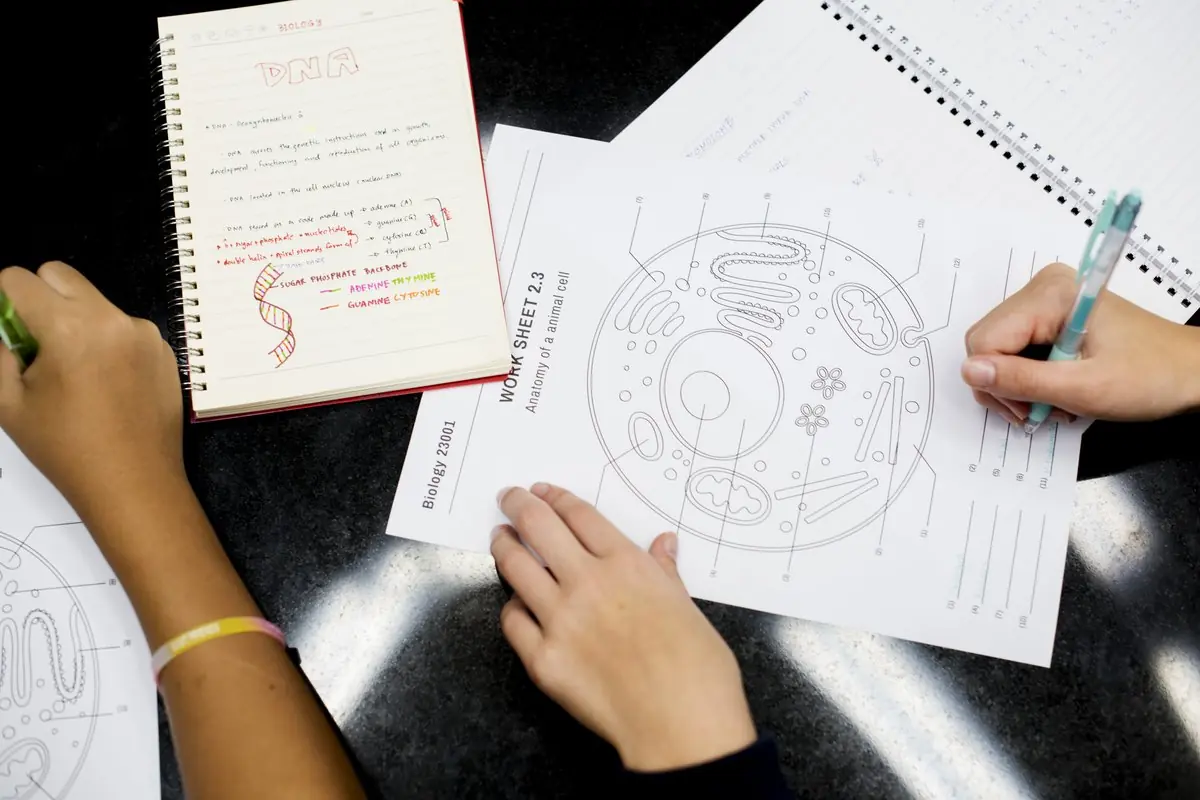
- Eukaryotic and prokaryotic cells; animal and plant cell structures and their functions
- Cell specialisation and differentiation
- Microscopy, including magnification calculations
- Chromosomes, mitosis and the cell cycle; stem cells
- Transport in cells: diffusion, osmosis and active transport
- Biology only: culturing microorganisms
Revise it by: drawing and labelling cells from memory, practising magnification = image size ÷ real size with unit conversions (mm to µm), and explaining diffusion, osmosis and active transport side by side in a table.
Topic 2: Organisation GCSE biology
- Levels of organisation: cells, tissues, organs, organ systems
- The digestive system and enzymes, including the lock and key model
- The heart, blood vessels and blood
- Coronary heart disease and other non-communicable diseases; risk factors
- Plant tissues and organs; transpiration and translocation
Revise it by: tracing the path of a meal through the digestive system, and the path of blood through the heart, out loud or as a flow chart. Practise interpreting graphs of enzyme activity and data on disease risk factors.
Topic 3: Infection and response
- Pathogens: viruses, bacteria, fungi and protists, with named examples
- Human defence systems and the immune system
- Vaccination, antibiotics and painkillers; drug discovery and development
- Biology only: plant disease; monoclonal antibodies (Higher only)
Revise it by: making a table of named diseases with pathogen type, how it spreads, symptoms, and prevention or treatment. This is ideal flashcard material; see our guide to making flashcards that work.
Topic 4: Bioenergetics GCSE
- Photosynthesis: word and symbol equations, limiting factors, uses of glucose
- Respiration: aerobic and anaerobic in animals and plants (and fermentation in yeast)
- Response to exercise; oxygen debt
- Metabolism
Revise it by: comparing photosynthesis and respiration in one table, and practising limiting factor graphs.
Required practicals in Paper 1
The AQA Biology (8461) specification places six required practicals within topics 1 to 4:
| Number | Practical | Topic |
|---|---|---|
| 1 | Use a light microscope to observe, draw and label plant and animal cells, with a magnification scale | Cell biology |
| 2 | Effect of antiseptics or antibiotics on bacterial growth, measuring zones of inhibition | Cell biology |
| 3 | Effect of salt or sugar concentration on the mass of plant tissue (osmosis) | Cell biology |
| 4 | Food tests: Benedict’s for sugars, iodine for starch, Biuret for protein, plus lipids | Organisation |
| 5 | Effect of pH on the rate of reaction of amylase | Organisation |
| 6 | Effect of light intensity on the rate of photosynthesis using an aquatic organism such as pondweed | Bioenergetics |
This list is from the separate Biology specification, so Trilogy students should check the Combined Science specification for their own list. For each practical, learn the method, the variables (independent, dependent, control), the risks and how to process the results. Our guide to GCSE science required practicals covers how they are examined.
A revision order for Paper 1
- Weeks 1 and 2: Cell biology. Everything else builds on it.
- Weeks 3 and 4: Organisation. Links back to cells, enzymes and transport.
- Week 5: Infection and response. Fact-heavy, so suits short daily flashcard sessions.
- Week 6: Bioenergetics. Links photosynthesis to plant organisation and respiration to exercise.
- Weeks 7 and 8: Required practicals and mixed past paper questions, timed to match the paper length.
For mocks this winter, a shorter version (one topic per week) still covers everything.
Within each week, mix methods rather than reading notes: one session drawing and labelling diagrams from memory, one session on flashcards, one on exam questions and one reviewing mistakes. A short end-of-week quiz on the previous topic keeps earlier material from fading while you move on, and it helps you link ideas across topics, such as enzymes from organisation and respiration from bioenergetics.
Three Paper 1 skills to practise with worked examples
Magnification with unit conversion
A cell measures 25 mm in a drawing. The drawing is magnified 500 times. What is the real size in micrometres? Real size = image size ÷ magnification = 25 ÷ 500 = 0.05 mm. There are 1000 µm in 1 mm, so 0.05 mm = 50 µm. Writing the formula first, then the conversion as a separate line, keeps the method clear.
Explaining an osmosis result
Potato cylinders lost mass in a concentrated sugar solution. Explain why. A strong answer links each step: the solution outside the cells had a lower water concentration than the cytoplasm; water moved out of the cells by osmosis, from a dilute to a more concentrated solution, across the partially permeable cell membrane; so the cylinders lost mass. Each “so” or “because” connects cause and effect, which is what explanation questions look for.
Reading a rate graph
A graph shows the rate of photosynthesis rising with light intensity, then levelling off. Describe both parts: the rate increases as light intensity increases, because light is the limiting factor; then the rate stays constant, because another factor, such as carbon dioxide concentration or temperature, has become limiting. Quote values from the graph where you can, with units.
Practising one example of each type every week builds the habits that turn knowledge into marks across the whole paper.
Common mistakes on Biology Paper 1
- Confusing diffusion, osmosis and active transport. Learn the precise definitions.
- Unit slips in magnification questions, especially between millimetres and micrometres.
- Saying enzymes are “killed” rather than denatured.
- Saying antibiotics treat viral infections.
- Vague answers to extended questions. Use key terms and link cause to effect.
Frequently asked questions
What topics are on AQA Biology Paper 1?
AQA GCSE Biology Paper 1 covers topics 1 to 4: cell biology, organisation, infection and response, and bioenergetics. This applies to both separate Biology (8461) and the biology paper in Combined Science: Trilogy (8464), although separate biology includes some extra content marked “biology only”.
How long is AQA Biology Paper 1?
For GCSE Biology (8461), Paper 1 is 1 hour 45 minutes, worth 100 marks and 50% of the GCSE. For Combined Science: Trilogy (8464), Biology Paper 1 is 1 hour 15 minutes, worth 70 marks and 16.7% of the qualification.
Which required practicals are on Biology Paper 1?
In the separate Biology (8461) specification, required practicals 1 to 6 sit in the Paper 1 topics: microscopy, antibiotics or antiseptics on bacterial growth, osmosis, food tests, the effect of pH on amylase, and light intensity on photosynthesis. Trilogy students should check the Combined Science specification for their list.
What is the best way to revise for GCSE biology Paper 1?
Revise topics in order, starting with cell biology, using active methods: draw and label diagrams from memory, make flashcards for diseases and definitions, and practise exam questions on each topic. Learn each required practical’s method and variables, then finish with timed past papers.
Get Paper 1 secure before the spring
Paper 1 rewards students who understand the foundations, so time spent on cell biology now pays off across the whole course. If your child would like support, our GCSE science tuition in Milton Keynes covers biology, chemistry and physics in small groups. To find the gaps, book a free assessment.
Next step: Book a free assessment with PrimePlus and we will identify gaps, explain where your child is now and suggest a clear plan. Book your free assessment.