A level physics maths is not an extra subject bolted on: it runs through every paper. AQA states that 40% of the overall A-Level Physics assessment contains mathematical skills equivalent to Level 2 or above, so a student who understands the physics but stumbles on logarithms, graphs or uncertainties is leaving a large share of marks behind. The good news is that the list of skills is fixed and published, and each one can be practised.
This guide is for students who like physics but feel less sure of their maths. It sets out what the specification asks for, then gives a method for each of the skills that cause the most trouble.
Key takeaways
- On AQA A-Level Physics (7408), 40% of the overall assessment contains maths at Level 2 or above.
- The specification lists the required skills in five groups: arithmetic, handling data, algebra, graphs, and geometry and trigonometry.
- Logarithmic graphs, uncertainties and areas under curves are among the skills the specification lists for the full A-Level.
- Several skills, such as standard form, rearranging and y = mx + c, are also used at GCSE, so gaps from Year 11 are worth fixing early in Year 12.
- Practise graphs and rearranging for a short time each week, rather than waiting until past-paper season.
In this guide, we’ll cover:
- How much maths is in A-Level Physics?
- The maths skills on the AQA physics list
- Rearranging physics equations at A-Level
- Graphs in A-Level physics: gradients, intercepts and areas
- Physics logarithms and log graphs
- Uncertainties in physics without the panic
- Trigonometry, radians and small angles
- Frequently asked questions
- Build the maths before the mocks
How much maths is in A-Level Physics?
The AQA 7408 scheme of assessment says that 40% of the overall assessment will contain mathematical skills equivalent to Level 2 or above. That maths is spread through the three papers rather than kept in one section:
| Paper | Raw marks | Approximate weighting |
|---|---|---|
| Paper 1 | 85 | 34% |
| Paper 2 | 85 | 34% |
| Paper 3 (Section A core, Section B optional topic) | 80 | 32% |
Expect to rearrange, substitute, read graphs and choose sensible significant figures throughout the papers. If you study AQA, the same maths habits will help in chemistry too; our guide to A-Level chemistry calculations covers the other side of that.
The maths skills on the AQA physics list
AQA’s mathematical requirements and exemplifications page groups the skills into five areas, coded MS 0 to MS 4. A summary:
| Group | What it includes |
|---|---|
| MS 0 Arithmetic and numerical computation | Units and prefixes, standard form, ratios and percentages, estimation, calculator use for powers, exponentials and logs, trig in degrees or radians |
| MS 1 Handling data | Significant figures, means, simple probability, orders of magnitude, combining uncertainties |
| MS 2 Algebra | Symbols such as ∝ and Δ, changing the subject, substituting with units, solving equations including quadratics, logarithms |
| MS 3 Graphs | Plotting, y = mx + c, gradient and intercept, tangents for rates of change, area under a curve, logarithmic plots, sketching relationships |
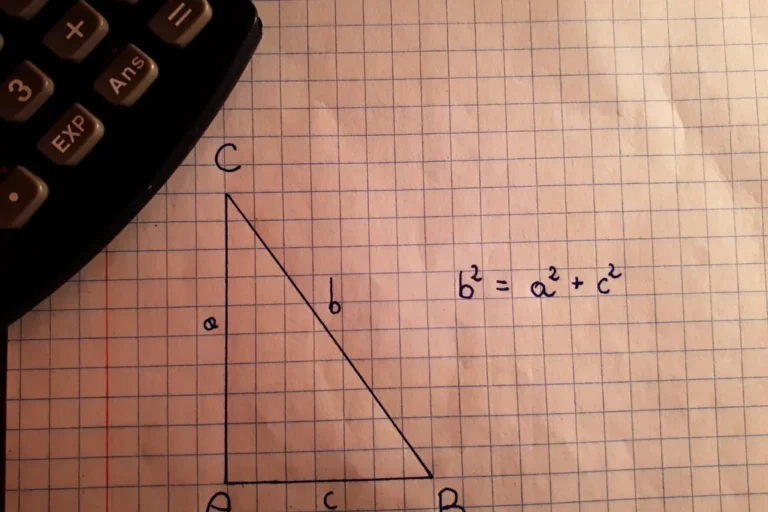
| MS 4 Geometry and trigonometry | Angles and force diagrams, areas and volumes, Pythagoras, resolving with sin and cos, small-angle approximations, degrees to radians |
Several skills are marked as A-Level only, including calculator use for exponentials and logs (MS 0.5), logarithms (MS 2.5) and interpreting and using logarithmic plots (MS 3.10 and 3.11). These are marked A-Level only in the specification, so give them extra practice.
Rearranging physics equations at A-Level
The specification asks you to change the subject of both linear and non-linear equations (MS 2.2). Students who were comfortable with GCSE physics equations, covered in our guide to which GCSE physics equations to learn, often struggle once squares, roots and fractions appear together.
A reliable method
- Write the equation and circle the quantity you want.
- Undo operations in reverse order: whatever was done to the circled quantity last, undo first.
- Do the same thing to both sides at every step, and write each step on a new line.
- Only substitute numbers at the end, with units, then check the answer’s size is plausible.
Worked example
Kinetic energy is E = ½mv². To find v: multiply both sides by 2 to get 2E = mv²; divide by m to get v² = 2E/m; take the square root to get v = √(2E/m). If E = 100 J and m = 2.0 kg, then v = √100 = 10 m s-1. Doing the algebra first keeps the working clean and makes errors easier to find.
Graphs in A-Level physics: gradients, intercepts and areas
Graphs are where physics and maths meet most often. The core idea is to make a relationship look like y = mx + c, so the gradient or intercept tells you a physical quantity.
- Gradient: use a large triangle covering at least half the line, and read points that sit exactly on the line, not data points.
- Intercept: read it from the graph only if the axis starts at zero; otherwise use y = mx + c with a point and the gradient.
- Tangent: for a curve, draw a tangent at the point and take its gradient as the instantaneous rate of change.
- Area under the curve: the specification gives the energy stored in a capacitor as one example of interpreting an area. On a velocity-time graph, the area gives displacement.
Always ask “what are the units of the gradient?” If the y-axis is in metres and the x-axis in seconds, the gradient is in m s-1, which tells you it is a velocity.
Physics logarithms and log graphs
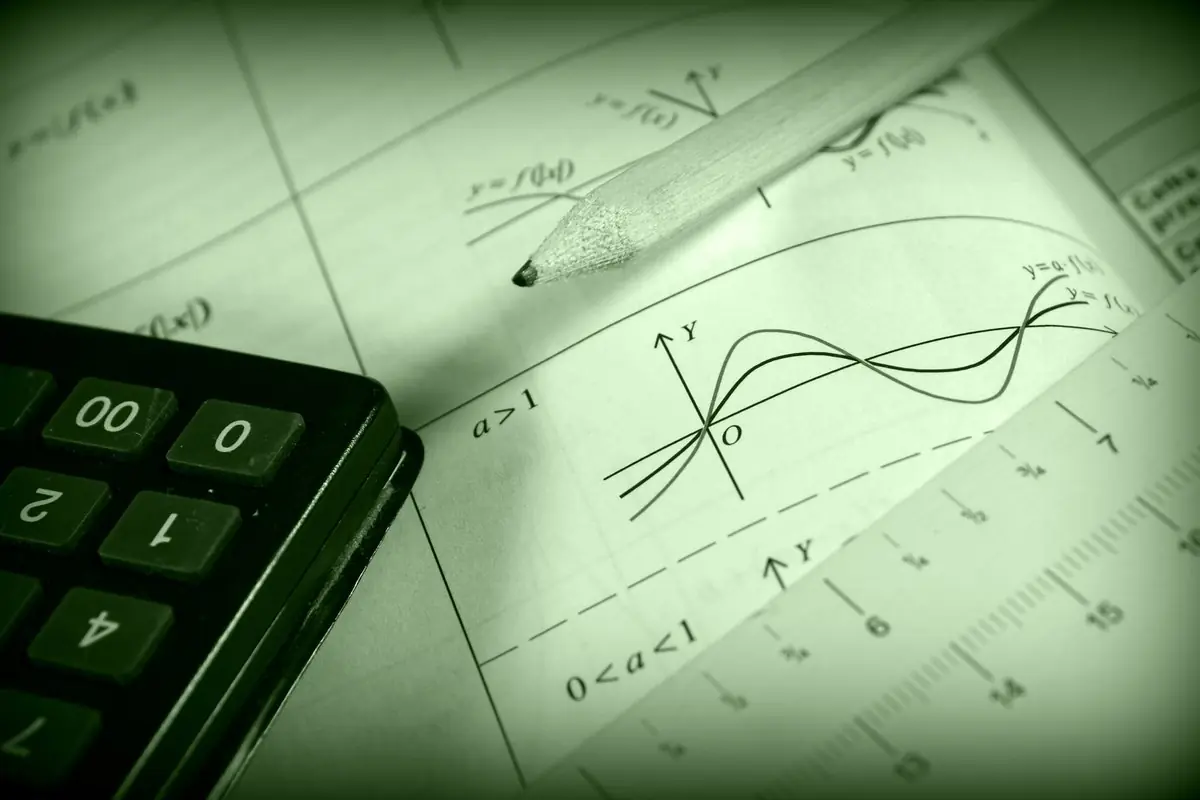
Logarithms appear because some quantities change exponentially, such as charge on a discharging capacitor or the activity of a radioactive source. Taking logs turns a curve into a straight line.
Exponential relationships
If y = Ae-kt, taking natural logs gives ln y = ln A – kt. Plot ln y against t and you get a straight line with gradient -k and intercept ln A. This is the idea behind finding a time constant from a log plot, which the specification lists under MS 3.10.
Power laws
If y = kxn, then log y = log k + n log x. Plot log y against log x: the gradient is n, the power. This is how you test whether data follows a power law (MS 3.11).
Common slips
- Logs have no units, so label the axis as ln(y / unit), for example ln(V / V).
- Know which log button your calculator uses: ln is base e, log is base 10.
- Find the original constant by undoing the log: if the intercept is ln A, then A = eintercept.
Uncertainties in physics without the panic
The specification asks you to determine uncertainties when data are added, subtracted, multiplied, divided or raised to powers (MS 1.5), and to report results to an appropriate number of significant figures (MS 1.1). Three rules cover most questions:
| Operation | What to combine |
|---|---|
| Adding or subtracting | Add the absolute uncertainties |
| Multiplying or dividing | Add the percentage uncertainties |
| Raising to a power n | Multiply the percentage uncertainty by n |
Example: a wire’s diameter is 0.50 ± 0.01 mm, a 2% uncertainty. Cross-sectional area depends on diameter squared, so the area has a 4% uncertainty. Remember to double it.
For significant figures, give the final answer to the same number as the least precise piece of data, and keep extra figures in your calculator during the working.
Trigonometry, radians and small angles
Resolving forces into components with sin and cos (MS 4.5) is used constantly in mechanics. Sketch the triangle, mark the angle, and say aloud which side is adjacent: the component next to the angle uses cos.
Radians come up in circular motion and oscillations. To convert, multiply degrees by π/180. Before an exam, check your calculator mode, because a calculator left in degrees during a radians question gives a wrong answer with no warning. The specification also lists small-angle approximations (sin θ ≈ θ, tan θ ≈ θ, cos θ ≈ 1), which only work with θ in radians.
If you are deciding whether to take A-Level Maths alongside physics, our guides to the jump from GCSE to A-Level Maths and choosing A-Level subjects may help.
Frequently asked questions
Do you need A-Level Maths to do A-Level Physics?
The AQA physics specification sets out its own list of maths skills, and it asks for rate-of-change problems to be solved graphically, without explicit calculus (MS 3.9). Entry requirements for physics, including whether maths is expected alongside it, are set by each sixth form or college, so look at the course page of the one you are applying to before choosing.
What maths is in A-Level Physics?
AQA groups it into arithmetic, handling data, algebra, graphs, and geometry and trigonometry. That covers standard form, significant figures, uncertainties, rearranging and solving equations, logarithms, gradients, tangents, areas under curves, log graphs, resolving vectors and radians. Several of these skills are marked A-Level only in the specification, including logarithms and log graphs.
How do you get better at physics maths?
Practise little and often. Each week, rearrange a few equations from your notes, draw and analyse one graph, and work through one uncertainty question. Write every step on a new line and include units. Keep a list of your own repeated mistakes and check it before each practice session.
Why do A-Level physics graphs use ln?
Exponential changes, such as capacitor discharge, produce curves. Taking the natural log of y turns y = Ae-kt into the straight line ln y = ln A – kt, so the gradient gives the constant k directly. Straight lines are much easier to analyse accurately than curves, which is why the technique is used.
Build the maths before the mocks
Pick the skill from this list you trust least and practise it three times this week. If you want structured support with physics and the maths inside it, our A-Level science tuition in Milton Keynes works through these skills in small groups and online. To find the gaps first, book a free assessment.
Next step: Book a free assessment with PrimePlus and we will identify gaps, explain where your child is now and suggest a clear plan. Book your free assessment.