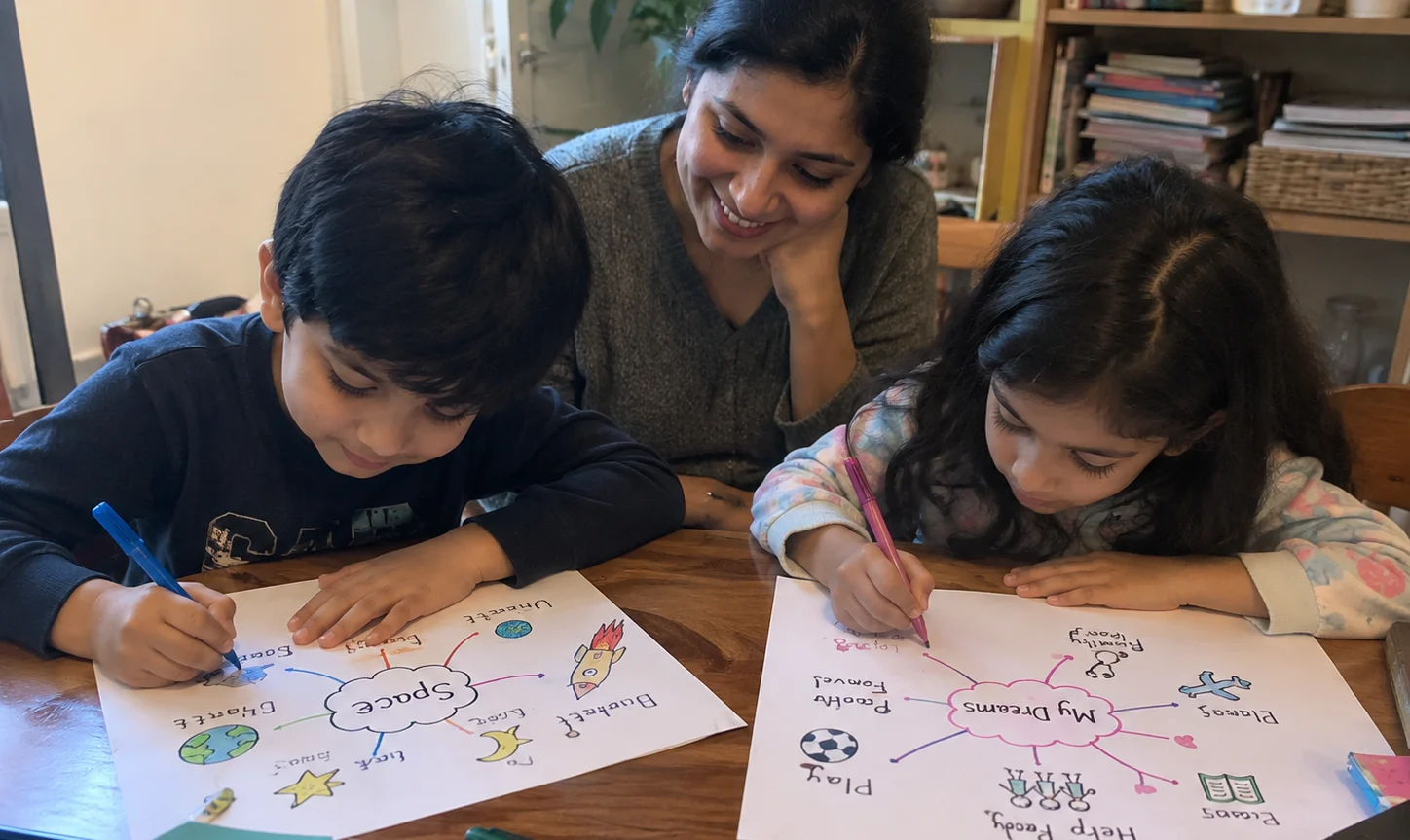
Many parents watch their children struggle with “revision” and wonder why information doesn’t stick. The truth is, most young learners haven’t been taught how to capture and organise information effectively. When children copy everything from the board word-for-word or forget what they’ve written minutes later, it’s often because they haven’t learned memory-friendly note-taking techniques.
The good news? Note-taking can be simple, visual, and even fun for children aged 5–11. Far from being a dry, academic skill, effective note-taking methods for students at this age focus on pictures, colours, keywords, and creative organisation rather than lengthy paragraphs.
At PrimePlus Tutoring, we introduce these practical study skills for primary school children within our 3-learner micro-groups. Small group tutoring Milton Keynes families trust allows children to learn from each other while receiving personalised guidance on how to take notes children can actually use and remember.
By the end of this guide, you’ll discover age-appropriate techniques including mind maps, sketch notes, keyword lists, and colour-coding systems. More importantly, you’ll learn how to practise these effective note-taking techniques at home, turning study sessions into engaging activities that boost memory and confidence.
In this guide, we’ll cover:
- Why Note-Taking Matters in Primary Years
- The Golden Rule – Notes Should Be Simple & Visual
- Child-Friendly Note-Taking Methods
- How Note-Taking Boosts Memory
- Common Mistakes to Avoid
- Practising Note-Taking at Home
- Why 3-Learner Groups Build Better Note-Takers
- Building Confident, Independent Learners
- Frequently asked questions
Why Note-Taking Matters in Primary Years
Building strong study habits early creates a foundation for academic success that extends far beyond primary school. When children learn how to capture information effectively, they develop critical thinking skills, improve their ability to organise thoughts, and build confidence for KS2 SATs and future challenges.
1Building the Habit Early
Note-taking serves multiple purposes for young learners. It helps them slow down and process information rather than passively listening. The act of writing or drawing forces children to engage actively with lessons, making learning more memorable and meaningful.
Research shows that students who take notes retain information better than those who simply listen. For primary-aged children, this skill becomes particularly valuable as curriculum demands increase and abstract concepts become more common.
2Common Struggles
Many children fall into predictable traps when first learning to take notes. They often copy everything from the whiteboard, believing that more information equals better notes. Others write word-for-word without stopping to understand meaning, creating pages of text they can’t recall later.
Some children become so focused on neat handwriting that they miss important verbal explanations. Others give up entirely when they can’t keep up with the pace of information sharing.
“The best notes aren’t longer – they’re clearer and easier to recall.”
The Golden Rule – Notes Should Be Simple & Visual
Children under 11 learn differently from teenagers and adults. Their brains respond better to visual information, colours, and concrete representations rather than abstract text blocks. This means effective note-taking for kids should prioritise pictures, keywords, arrows, and creative layouts over traditional paragraph formats.
The goal isn’t to write everything down – it’s to trigger memory. Think of notes as memory cues rather than complete records. When children create visual representations of information, they engage multiple areas of their brain, strengthening neural pathways that support long-term retention.
Scientific research supports this approach. The dual coding theory suggests that our brains process visual and verbal information through separate channels. When children combine pictures with keywords, they create stronger, more accessible memories than text alone could provide.
This visual approach also makes studying more enjoyable. Children who associate note-taking with creativity and personal expression are more likely to continue using these study tips for ages 11 and under throughout their educational journey.
Child-Friendly Note-Taking Methods
1Mind Maps
Mind maps transform linear information into visual, branched diagrams that mirror how children naturally think. Start by placing the main topic in the centre of the page, then draw branches radiating outward for subtopics and supporting details.
Encourage children to use different colours for each branch, add small doodles or symbols, and write only essential keywords rather than full sentences. This approach works particularly well for science topics, story planning, geography facts, or character analysis in English lessons.
The beauty of mind maps lies in their flexibility. Children can add new branches as they learn more, creating a growing visual representation of their knowledge. The central focus point helps maintain attention while the branching structure shows relationships between ideas.
For younger children (ages 5–7), start with simple three-branch maps. Older primary students can handle more complex structures with sub-branches and detailed connections.
Activity idea for parents: Help your child create a mind map of their favourite animal. Place the animal’s name in the centre, then add branches for habitat, food, appearance, and interesting facts. Use colours and small drawings to make it memorable.
Practice this technique with familiar topics first – favourite books, family holidays, or hobbies – before applying it to academic subjects.
2Keyword Lists
Teaching children to identify and record only the most important words helps them focus on essential information rather than getting lost in details. This method works particularly well for spelling lists, mathematical procedures, vocabulary definitions, or science facts.
The key is selectivity. Children should aim for 3–5 keywords per main idea, choosing words that will trigger their memory of the broader concept. Bullet points or numbered lists provide clear organisation without overwhelming visual clutter.
To make keyword lists more effective, encourage children to write words in their own handwriting rather than copying exactly from textbooks or whiteboards. The physical act of writing reinforces memory, while personal word choices create stronger mental connections.
Memory tricks for students: After creating a keyword list, ask your child to cover it and try recalling the main points. Then uncover the list for self-checking. This active recall practice strengthens memory pathways more effectively than passive re-reading.
For mathematical problems, keyword lists might include “multiply,” “remainder,” “estimate” for specific problem types. In history, keywords might capture “cause,” “effect,” “date,” “location” for historical events.
3Picture Notes / Sketch Notes
Visual learners benefit enormously from combining quick sketches with text. These don’t need to be artistic masterpieces – simple stick figures, basic shapes, and symbolic representations work perfectly for capturing and remembering information.
Picture notes engage different areas of the brain than text-based notes, creating multiple pathways to the same information. When children draw concepts, they process information more deeply, leading to better understanding and retention.
Encourage children to develop personal visual vocabulary. Fractions might become pizza slices, the water cycle could be represented with cloud and sun symbols with arrows, historical figures might become distinctive stick drawings.
The combination of visual and motor memory created through drawing makes information particularly sticky. Children often surprise themselves by remembering details from sketch notes weeks or months later.
Practical examples: For science lessons, simple diagrams showing plant parts, animal life cycles, or weather patterns work better than lengthy descriptions. In English, character emotion charts or story sequence drawings help children organise narrative elements.
Start by demonstrating that artistic skill isn’t required – focus on clarity and personal meaning rather than aesthetics.
4Colour-Coding
Strategic use of colour transforms ordinary notes into organised, visually appealing study tools. Assign specific colours to different types of information: blue for definitions, green for examples, red for important rules or warnings, yellow for questions to ask later.
Colour-coding helps children categorise information automatically as they write, improving both organisation and recall. The visual distinction makes it easier to locate specific types of information when reviewing notes later.
This method works particularly well for subjects with clear categories. In mathematics, different colours might represent different operation types. In English, colours could distinguish between character descriptions, plot points, and vocabulary words.
Consistency is crucial for colour-coding success. Help your child develop a personal colour system and stick with it across subjects and time periods. This builds automatic habits that support independent learning.
Young children enjoy the creative aspect of colour-coding, making study time more engaging and less intimidating.
5Graphic Organisers
Structured templates like Venn diagrams, flow charts, story maps, and comparison tables provide frameworks that help children organise their thinking. These visual tools work particularly well for complex topics requiring analysis, comparison, or sequencing.
Venn diagrams excel for comparing and contrasting characters, historical periods, or scientific concepts. Flow charts help children understand processes like mathematical problem-solving steps or scientific procedures. Story maps support comprehension by visually organising plot elements, characters, and settings.
The structured nature of graphic organisers removes the intimidation factor many children feel when facing blank paper. Having a clear framework helps them focus on content rather than worrying about organisation.
These tools also make abstract thinking more concrete. Children can physically see relationships between ideas, making complex concepts more accessible and memorable.
Implementation tip: Start with simple templates and gradually introduce more complex organisers as children become comfortable with the approach. Many children enjoy creating their own variations once they understand the basic principles.
How Note-Taking Boosts Memory
The act of writing engages multiple cognitive processes that strengthen memory formation. When children actively select, organise, and record information, they move beyond passive listening to active learning. This engagement creates stronger neural pathways and more durable memories.
Visual elements in notes provide retrieval cues that help children access stored information more easily. A coloured keyword or small drawing can trigger recall of entire concepts, making studying more efficient and effective.
Explaining notes aloud to parents, siblings, or study partners further strengthens memory. This verbal processing helps children identify gaps in understanding while reinforcing learned material through multiple sensory channels.
In small group tutoring Milton Keynes settings like our 3-learner micro-groups, tutors can immediately assess whether children’s notes actually make sense to them. This real-time feedback helps refine note-taking techniques and ensures children develop genuinely useful study skills for primary school success.
The social aspect of sharing notes with peers also builds confidence. Children discover that different approaches can be equally valid, encouraging them to develop personal systems that work for their learning style.
Common Mistakes to Avoid
Many children initially try to capture every word their teacher says, creating overwhelming volumes of text they can’t process effectively. Teaching selectivity – focusing on main ideas and key details – helps children create more useful, memorable notes.
Excessive focus on neat handwriting often slows down thinking and causes children to miss important information. While legibility matters, content and understanding should take priority over perfect penmanship during note-taking activities.
Writing complete sentences instead of keywords makes notes unnecessarily long and difficult to review quickly. Encourage abbreviations, symbols, and shorthand that your child understands and can read later.
Copying without understanding creates notes that look comprehensive but provide little value for learning or revision. Always check that your child can explain their notes in their own words.
Practising Note-Taking at Home
Start with enjoyable, familiar topics to build confidence before tackling academic subjects. Ask your child to create mind maps about their favourite TV programmes, sports teams, or video games. This removes pressure while building essential skills.
Mini-whiteboards or large sheets of paper work better than small notebooks for beginners. The extra space allows for creative layouts and reduces anxiety about making mistakes. Children can easily erase and adjust their visual notes as they develop their personal style.
Practical exercise: Read a short, interesting passage aloud while your child creates keyword lists or sketch notes. Start with 2–3 minute passages and gradually increase length as skills develop. Focus on celebrating effort and creativity rather than perfect accuracy.
Encourage experimentation with different methods. Some children naturally gravitate toward mind maps while others prefer lists or pictures. Supporting their preferences builds confidence and ensures they’ll continue using these techniques independently.
Share and celebrate your child’s notes. Display particularly creative examples and ask them to explain their choices. This positive reinforcement strengthens the association between note-taking and success.
Why 3-Learner Groups Build Better Note-Takers
Small group environments provide unique advantages for developing note-taking skills. Children can compare their notes with peers, discovering that different approaches can be equally effective. This exposure to variety encourages flexibility and creativity in their own note-taking development.
Peer sharing builds confidence in ways that individual instruction cannot match. When children see that their ideas and methods work for others, they develop greater faith in their abilities. The collaborative environment reduces anxiety while maintaining focus and engagement.
Tutors in 3-learner groups can model effective techniques, then provide personalised guidance as children practice. This balanced approach ensures children understand core principles while developing personal systems that match their learning preferences.
The absence of overwhelming group dynamics (unlike larger classes) combined with peer interaction (unlike one-to-one tutoring) creates an ideal learning environment. Children feel comfortable asking questions and trying new approaches without fear of judgment.
Ready to see these techniques in action?
Book a Free Assessment to discover how our 3-learner groups teach practical note-taking skills that support long-term academic success.
Building Confident, Independent Learners
Note-taking success isn’t measured by neatness or volume – it’s about helping children remember more while making learning enjoyable and sustainable. Mind maps, keywords, sketches, and colour-coding transform information capture from a chore into a creative, engaging process.
These effective note-taking techniques work because they align with how young brains naturally process and store information. When children combine visual elements with selective writing, they create powerful memory tools that support academic success across all subjects.
Parents play a crucial role by providing opportunities for low-pressure practice at home. Starting with familiar, interesting topics builds confidence and skills that transfer seamlessly to academic contexts.
PrimePlus Tutoring’s micro-groups (maximum 3 learners) provide the ideal environment for turning these methods into lasting study skills for primary school success. Children develop personal systems while benefiting from peer learning and expert guidance.
Frequently Asked Questions
What is the best note-taking method for primary children?
Mind maps and sketch notes work particularly well for ages 5–11 because they’re visual, engaging, and mirror how children naturally think. These methods combine pictures with keywords, creating multiple memory pathways that support better recall.
Should my child write full sentences in notes?
No. Short keywords, bullet points, doodles, and simple diagrams are far more effective for recall than complete sentences. The goal is triggering memory, not creating comprehensive written records.
How can I help my child practise note-taking at home?
Start with fun, familiar topics like favourite animals, TV shows, or hobbies. Read short passages aloud and ask your child to create mind maps or keyword lists of the main points. Focus on creativity and effort rather than perfection.
Is note-taking useful before age 11?
Absolutely. Early practice helps children organise their thoughts, engage actively with learning, and develop confidence for more complex academic challenges. These skills provide particular advantages for KS2 SATs and secondary school preparation.
Do small groups help with study skills like note-taking?
Yes. In micro-groups of 3, children share ideas, learn from different approaches, and receive personalised guidance from tutors. This environment builds confidence while ensuring children develop effective, personal note-taking systems.
Help your child become a confident, independent learner.
Book your Free Assessment today to discover how our small group approach develops practical note-taking skills that make a real difference to academic achievement and lifelong learning success.